Are Insurance Claim Payouts Taxable? What Property Owners Need to Know
You fought for months to get your claim paid. Here is exactly when property insurance proceeds are tax free, when they are not, and what to do about it.

TL;DR:
- Insurance proceeds for property damage are generally not taxable income. They reimburse a loss; they do not enrich you.
- A payout becomes taxable only when it exceeds your adjusted basis, most often on long-held homes and depreciated rental or commercial buildings.
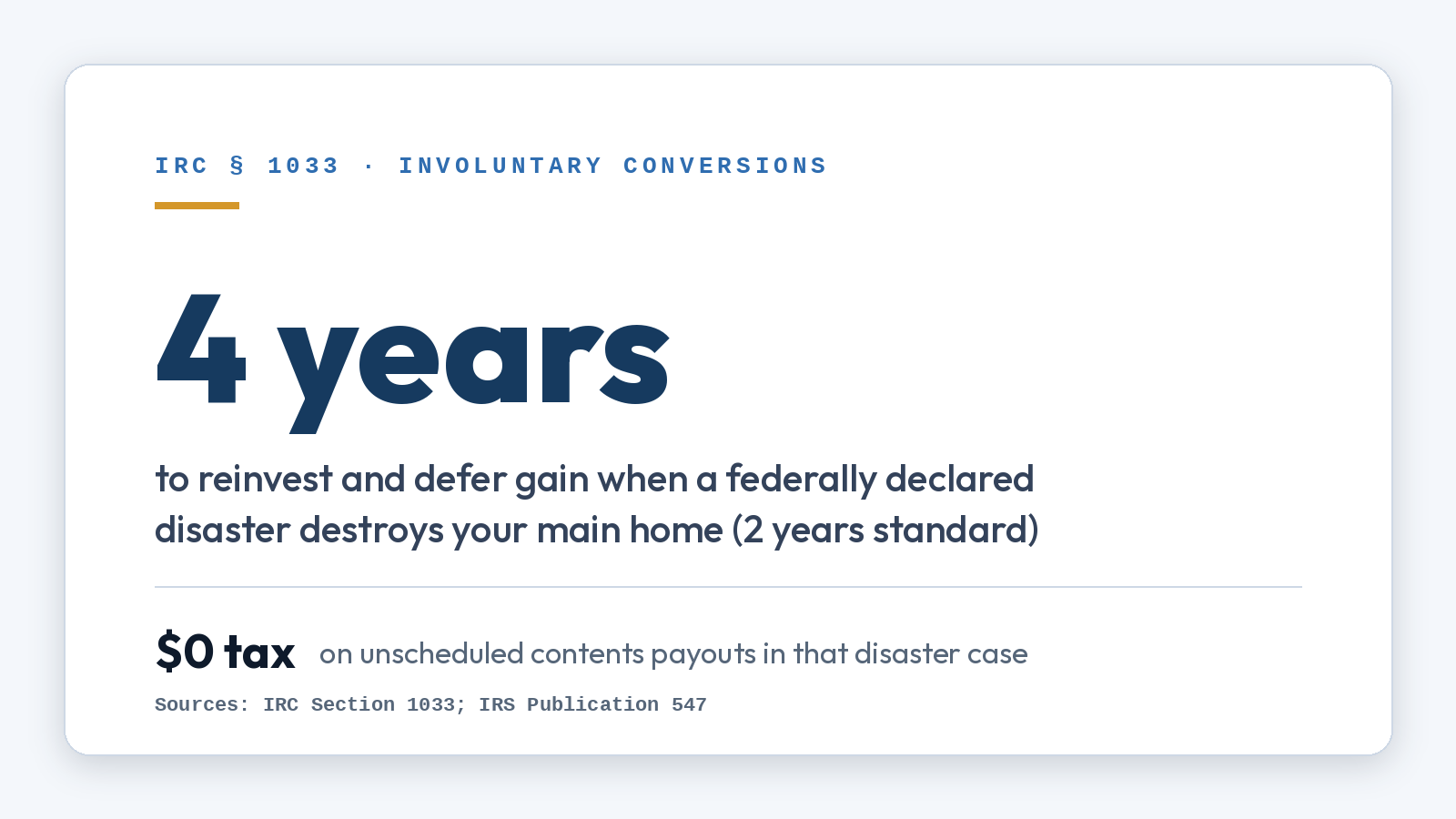
- Even then, IRC Section 1033 usually lets you defer the entire gain by replacing the property in time: generally 2 years, or 4 for a disaster-area main home.
- For a destroyed main home, the Section 121 exclusion can wipe out up to $250,000 of gain ($500,000 married filing jointly) before deferral is even needed.
- ALE checks and disaster-area payments get favorable rules under IRS Publication 547. Keep every settlement document; call a CPA on any large payout.
Insurance proceeds for property damage are generally not taxable, because the IRS treats them as reimbursement for a loss rather than income. IRS Publication 547 is built around a simple idea: a claim check that restores what a fire, hurricane, or pipe burst took away leaves you no better off than before, so there is nothing to tax, and a routine homeowners claim payment never appears on your Form 1040.
The exceptions are narrow but real, and they cluster around large settlements: a payout bigger than your adjusted basis in the property, insurance that replaces lost rental or business income, and living expense checks that overshoot actual costs. Each has a rule, a form, and usually a legal way to avoid or defer the tax. This guide walks through them using IRS sources, because at Vanguard Claims Solutions we see homeowners panic over phantom tax bills and, more dangerously, miss the deadlines that keep a real gain deferred.
Are insurance claim payouts taxable?
No, the typical claim payout is not taxable and does not appear on your tax return. Publication 547 states the rule plainly: a reimbursement only creates a gain "if your reimbursement is more than your adjusted basis in the property." Below that line, the money is a nontaxable recovery of what you already owned. A $60,000 check to rebuild a roof on a home you bought for $350,000 generates no tax bill, whether you spend it on repairs or not.
Where taxes and claims usually intersect is the opposite direction: the loss side. If insurance did not cover the full damage, you may have a deductible casualty loss on Form 4684. Under current law, personal casualty losses are generally deductible only when attributable to a federally declared disaster (check FEMA's database), trimmed by a $100 per event floor and 10% of adjusted gross income, per IRS Topic 515. The rest of this article covers the minority of claims, usually the largest, where the payout itself can create tax.
When can a property insurance payout become taxable?
A payout becomes potentially taxable when total proceeds for the damaged property exceed your adjusted basis in it. Publication 547 calls this a casualty gain, and the excess counts even though you never chose to "sell" anything. When recognized, it is generally taxed under capital gain rules, which is why tax professionals call it an insurance payout capital gain.
What is adjusted basis?
Adjusted basis is, roughly, what you have invested in the property for tax purposes:
- Start with your purchase price (or the value used when you inherited or were gifted it).
- Add capital improvements: the new roof, the addition, the kitchen renovation.
- Subtract depreciation claimed (rental and business property), prior casualty loss deductions, and prior recoveries not spent on restoration.
Publication 551, Basis of Assets covers the mechanics. Basis is what you paid, not what the property is worth today.

Who actually ends up with a gain?
In practice, casualty gains show up in three situations we see repeatedly:
- Long-held homes in appreciated markets. A house bought decades ago for $120,000 that produces a $480,000 total-loss payout against a $150,000 adjusted basis has a $330,000 realized gain.
- Depreciated rental and commercial buildings. Depreciation lowers basis every year, so even a partial-loss settlement can exceed what is left.
- Replacement cost payouts on older structures. Policies paying today's rebuild prices against yesterday's purchase price are exactly where gain comes from.
Realizing a gain is not the same as paying tax on it. The next two sections cover the tools that eliminate the bill for most owners who plan ahead.
How does the Section 1033 involuntary conversion deferral work?
IRC Section 1033 lets you postpone the entire gain if you use the proceeds to buy or build replacement property "similar or related in service or use" to what you lost, within a set period. The tax code calls this an involuntary conversion: your house was converted into money against your will, so you get time to convert the money back into a house without a tax event.
The mechanics that matter:
- Reinvest at least the full proceeds to defer all of the gain; if the replacement costs less, Publication 547 requires you to recognize gain to the extent of the shortfall.
- The deferred gain is not forgiven. Your basis in the replacement property is reduced by the postponed gain, so the tax surfaces only if you later sell in a taxable sale.
- The clock runs from year end, not the date of loss. Under Section 1033(a)(2)(B), the standard period ends 2 years after the close of the first tax year in which any part of the gain is realized, generally the year the proceeds arrive.
Replacement periods at a glance
| Situation | Replacement period | Source |
|---|---|---|
| Standard involuntary conversion (most property) | 2 years after the close of the first tax year any part of the gain is realized | IRC § 1033(a)(2)(B) |
| Main home (or contents) in a federally declared disaster area | 4 years after the close of that first tax year | IRS Pub 547; IRS disaster FAQs |
| Business or investment real property condemned by a government | 3 years | IRC § 1033(g)(4) |
| Any of the above, with reasonable cause | Extended on written application to the IRS | IRS Pub 547 |
Special rules when a federally declared disaster destroys your main home
Publication 547 layers three homeowner-friendly rules on top when your main home sits in a federally declared disaster area:
- No gain on unscheduled personal property. "No gain is recognized on any insurance proceeds received for unscheduled personal property that was part of the contents of the home." The furniture, clothing, and electronics payout is tax free with nothing to reinvest.
- One pooled bucket for the home and scheduled items. Proceeds for the dwelling and scheduled valuables are "treated as received for a single item of property," and anything similar in use to the home or its contents counts as replacement for that pool, which often makes full deferral easy.
- Four years instead of two to complete the replacement. These rules even extend to renters whose damaged property was in a rented main home.
How you actually claim the deferral
There is no special election form. You attach a required statement to the return for the year of the gain describing the conversion and the replacement, per Publication 547; if you have not replaced yet, you state your intent, then report the replacement (or any recognized gain) when it happens. Two cautions: property bought from certain related parties generally cannot serve as replacement, and if the deadline threatens to lapse mid-rebuild, ask the IRS in writing for an extension before it ends.
Pro Tip: Calendar the replacement deadline the day the first big settlement check clears, using the end of that tax year plus 2 or 4 years, and give that date to your CPA and your contractor.
Does the home-sale exclusion apply when your home is destroyed?
Yes. The destruction of a main home is treated like a sale for purposes of the Section 121 exclusion, so up to $250,000 of gain ($500,000 married filing jointly) can be excluded outright, not merely deferred, provided you owned and used the home as your main residence for at least 2 of the 5 years before the loss. The IRS's hurricane FAQs confirm that when a destroyed home's lot is later sold, the destruction and sale are a single involuntary conversion, so the exclusion covers the combined gain.
The two provisions stack, and the order matters:
- First, exclude up to $250,000/$500,000 under Section 121. For many homeowners this erases the entire casualty gain for good.
- Then, defer any remaining gain under Section 1033 by replacing the home within the 4-year disaster window (or 2-year standard window), per the IRS disaster FAQs.
A couple with a $600,000 gain on a destroyed Florida home can exclude $500,000 and only needs Section 1033 for the last $100,000. Worksheets are in Publication 523, Selling Your Home.
How are ALE checks, contents, and rental or business payouts taxed?
Each category of payment has its own answer, which is why the coverage breakdown matters as much as the total.
| Payment type | General federal tax treatment |
|---|---|
| Dwelling repair/rebuild proceeds | Tax free up to adjusted basis; excess is gain, usually excludable or deferrable (Pub 547) |
| Additional living expenses (ALE) | Tax free up to the temporary increase in living costs; fully tax free in a federally declared disaster area (Pub 547) |
| Unscheduled personal property, disaster-destroyed main home | No gain recognized at all (Pub 547) |
| Rental/commercial building proceeds | Gain to the extent proceeds exceed depreciated basis; deferrable under § 1033 |
| Lost rent / business interruption | Ordinary taxable income, like the income it replaces (IRS guidance) |
Additional living expenses (ALE)
If your home is uninhabitable, ALE coverage pays for hotels, rent, and extra food costs. Publication 547 makes these payments nontaxable up to your "temporary increase" in living expenses: what you actually spent while displaced minus what you would normally have spent. Only a payment above that increase is income (Schedule 1, line 8z), and even that rule has a broad carve-out: "if the casualty occurs in a federally declared disaster area, none of the insurance payments are taxable." Since most Florida and South Carolina hurricane claims arise inside federal declarations, most ALE checks never touch a tax return. Keep displacement receipts anyway.
Personal property and contents
Outside the disaster no-gain rule above, contents payouts follow the same basis logic as the building: tax free up to what the items cost you, which makes taxable gains on ordinary household goods rare. Scheduled valuables that appreciated, such as jewelry or a collection insured above what you paid, are the exception worth flagging to a CPA.
Rental and commercial property
This is where owners get caught. Years of depreciation push adjusted basis down, so a settlement that merely restores the building can still exceed basis and create a gain, part of which can be taxed under the recapture rules for depreciated real estate. The Section 1033 deferral is available for business and investment property too, including a special disaster rule that treats replacement business property broadly as similar in use. Any coverage that replaces income, such as lost rent or business interruption, is ordinary taxable income, exactly as the rent or profits would have been, per IRS settlement guidance. Owners of commercial claims should have a CPA review the settlement allocation before year end.
What about Florida and South Carolina state taxes?
Florida levies no personal income tax; the prohibition sits in the Florida Constitution (Article VII, Section 5). South Carolina's income tax starts from "federal taxable income," per the SC Department of Revenue, so a gain excluded or deferred federally generally stays that way for SC, while a recognized gain is taxed at rates topping out at 6% for 2025.
What records should you keep, and when do you need a CPA?
Keep every document that establishes basis, proceeds, and replacement, because those three numbers decide whether any of this is taxable:
- Basis records: purchase closing statement, capital improvement invoices, depreciation schedules for rental or business property.
- Settlement records: the insurer's payment breakdown by coverage (dwelling, other structures, contents, ALE, lost rent), check stubs, the adjuster's estimate.
- Loss documentation: photos, inventories, and repair invoices, which also support any Form 4684 casualty loss on the uninsured portion.
- Replacement records: contracts, draws, and closings proving what you spent and when, to support the Section 1033 statement.
Pro Tip: Ask your insurer in writing for a payment ledger broken out by coverage; the tax treatment of a $400,000 settlement depends entirely on how it splits across dwelling, contents, ALE, and lost income.
Bring in a CPA whenever proceeds might exceed basis, whenever the claim involves rental or business property or lost income coverage, and always on a total loss. The deferral elections are cheap to get right in the year of the gain and expensive to repair afterward. This article is general information, not tax or legal advice; the result depends on your policy, your basis records, and the facts of your claim, so confirm your situation with a qualified tax professional.
Key Takeaways
| Point | Details |
|---|---|
| Default rule | Proceeds are reimbursement, not income; routine claim payments are not reported or taxed (Pub 547) |
| When tax appears | Only when proceeds exceed adjusted basis (price + improvements, minus depreciation) |
| Main escape hatch | Section 1033 deferral: reinvest in similar property within 2 years, or 4 for a disaster-area main home (IRC § 1033) |
| Main home bonus | Section 121 excludes up to $250,000/$500,000 of gain on a destroyed principal residence (Topic 701) |
| Disaster-area perks | No gain on unscheduled contents, pooled replacement rules, tax-free ALE (Pub 547) |
| Always taxable | Coverage replacing income (lost rent, business interruption) is ordinary income (IRS guidance) |
What we see in the field
We rarely meet a policyholder who owes surprise tax on a claim, but we constantly meet policyholders who fear they will, and that fear costs real money. Owners shave their contents inventory because a bigger settlement "means a bigger tax bill," or hesitate to pursue a supplemental payment they are owed. Leaving covered damage unclaimed trades a guaranteed loss for a tax that usually never materializes.
The second pattern is the opposite failure: large settlements where nobody watches the calendar. The Section 1033 window runs from the end of the tax year the gain lands, and rebuild timelines after a major hurricane routinely stretch past two years between permitting, contractor backlogs, and supplemental negotiations. The four-year disaster window exists because the IRS knows this, yet owners who never filed the deferral statement, or never realized their payout exceeded a depreciated basis, can turn a solvable timing issue into a recognized gain.
The third thing we watch is the settlement allocation itself. Insurers issue checks by coverage line, and that allocation quietly drives the tax answer: dwelling, contents, ALE, and lost rent dollars each live under a different rule. We keep that paper trail clean, itemized, and matched to the policy, because eighteen months later a CPA will reconstruct the whole claim from those documents. Claim everything the policy owes you, document everything, and put a CPA next to your adjuster on any six-figure settlement.
- The Vanguard field team
How Vanguard Claims Solutions helps
Vanguard Claims Solutions is a licensed public adjusting firm representing property owners, not insurers, in Florida and South Carolina. We document the full scope of your damage, negotiate the settlement your policy actually owes, and deliver the itemized paper trail your CPA needs at tax time. The claim review is free, there are no upfront fees, and we work on contingency: no recovery, no fee, with the fee for your claim set out in the written contingency agreement before you sign. Your claim is handled by Andrew Pichardo, FL Public Adjuster License #W493213 and SC License #18873906. Call (305) 336-3302 or request your free claim review.
FAQ
Do I have to report a home insurance claim on my tax return?
Usually no. A payout that reimburses property damage is not income and has no reporting line, per IRS Publication 547. You only report when proceeds exceed your adjusted basis, when you claim a Form 4684 casualty loss for uninsured damage, or when a payment replaces taxable income such as lost rent.
Is an insurance settlement considered income by the IRS?
Not when it compensates for physical damage to property you own; the IRS treats it as a recovery of your investment. Portions that replace income, such as business interruption or lost rent, are ordinary income under IRS settlement guidance.
Do you pay capital gains tax if the insurance payout is more than you paid for your house?
Only if you do nothing about it. The excess over adjusted basis is a gain, but the Section 121 exclusion shields up to $250,000 ($500,000 joint) on a main home, and Section 1033 defers the rest if you rebuild or replace within the replacement period.
Are insurance proceeds taxable for rental property?
Same basis rule, smaller cushion: depreciation lowers basis each year, so rental settlements produce gains more often. The gain can generally be deferred under Section 1033, while lost-rent coverage is ordinary taxable income. Get a CPA involved before the settlement year closes.
Are additional living expense (ALE) payments from my insurer taxable?
Generally no. Publication 547 excludes ALE payments up to your temporary increase in living costs while displaced, and when the casualty occurs in a federally declared disaster area, none of the ALE insurance payments are taxable at all. Keep displacement receipts to document the numbers.
Recommended
Dealing with this claim right now?
A licensed adjuster will review your loss and policy for free, with no obligation.