What Is a Proof of Loss? How to Complete One Without Hurting Your Claim
Your insurer just demanded a "sworn statement in proof of loss" with a deadline attached. Here is what that document is, how binding it is, and how to complete it without hurting your own claim.

TL;DR:
- A proof of loss is a signed, sworn statement of the amount you are claiming under your policy. It is not the claim report, and it is not the adjuster's estimate.
- Most standard homeowners policies require it within 60 days of the insurer's written request. Missing that window can jeopardize coverage.
- NFIP flood claims are stricter: a sworn proof of loss is due within 60 days of the date of loss, and federal courts enforce that hard unless FEMA formally extends it.
- Because the document is sworn, guessed numbers, understated amounts, or inconsistencies can be used against you later, up to and including fraud and concealment defenses.
- You can get help before you sign, so the number you swear to is one you can defend.
A proof of loss is a formal, signed and sworn statement in which you tell your insurance company, under oath, the amount you are claiming for a covered loss, along with supporting facts such as the date, cause, and extent of the damage. It is a policy condition, not a courtesy: the widely used ISO HO-3 homeowners form lists a "signed, sworn proof of loss" among your duties after loss, and noncompliance with post-loss duties is one of the most common technical grounds insurers cite when disputing claims.
The demand usually arrives when a claim is contested, large, or slow moving. It is manageable if you meet the deadline and never swear to a number you cannot support, and that is exactly the point where firms like Vanguard Claims Solutions get called in.
What is a proof of loss, and how is it different from filing a claim?
A proof of loss is your sworn statement of the amount claimed; it is not the phone call or online form you used to report the damage. Reporting the loss (the "notice of claim") starts the claim. The proof of loss comes later and pins down, under oath, what you say the insurer owes. Florida consumer guidance describes the sequence the same way: prompt notice, protect and document the property, then, if required, a sworn proof of loss, typically within 60 days of the request.
Three documents get confused constantly, and mixing them up is how homeowners get hurt:
| Document | What it is | Who prepares it | Sworn? |
|---|---|---|---|
| Notice of claim | The initial report that a loss occurred | You (call, portal, or letter) | No |
| Estimate / scope | Itemized calculation of repair or replacement cost | A contractor, the carrier's adjuster, or your public adjuster | No |
| Proof of loss | Formal statement of the amount claimed and key facts | You (signed and sworn, usually notarized) | Yes |
The estimate is an opinion of cost. The proof of loss is your sworn position in the claim, and when it conflicts with your own documents or recorded statements, the carrier's lawyers will notice.
How does a proof of loss differ from an examination under oath?
A proof of loss is a written statement you prepare and sign. An examination under oath (EUO) is live questioning by the insurer's attorney, transcribed by a court reporter. Standard policies can require both, and refusing to comply with either can forfeit coverage. If an EUO notice follows your proof of loss, expect the questioning to test the sworn numbers you already submitted.
What does a proof of loss form actually ask for?
A proof of loss form asks you to state, under oath, the essential facts of the loss and the dollar amount you are claiming, usually broken out by coverage. Forms vary by carrier, but the federal flood program's version is a useful model because its required contents are spelled out in regulation. Under the Standard Flood Insurance Policy Dwelling Form, the proof of loss must include, among other items, the date, time, and cause of loss, interests in the property, other insurance, detailed repair estimates, lienholders, and an inventory of damaged personal property.

Homeowner policy forms track the same themes. In practice, expect fields for:
- Policy and identity details. Policy number, named insureds, property address, mortgagees and lienholders.
- Loss facts. Date, time, and cause of loss, and any other interests in the property or claim.
- Other insurance. Any other policies that might respond to the same loss.
- The amount claimed. Often split by coverage: dwelling, other structures, personal property, additional living expenses.
- Supporting documentation. Estimates, inventories, receipts, photos, and reports attached or referenced.
Two points matter more than the blanks. The amount claimed should trace to documents you actually possess: a line-item estimate, a contents inventory, invoices. And the signature block typically requires notarization and includes fraud language; you are certifying everything above your signature.
Pro Tip: Build the estimate and inventory first, then fill in the proof of loss from those documents, never the other way around.
What deadline applies, and what happens if you miss it?
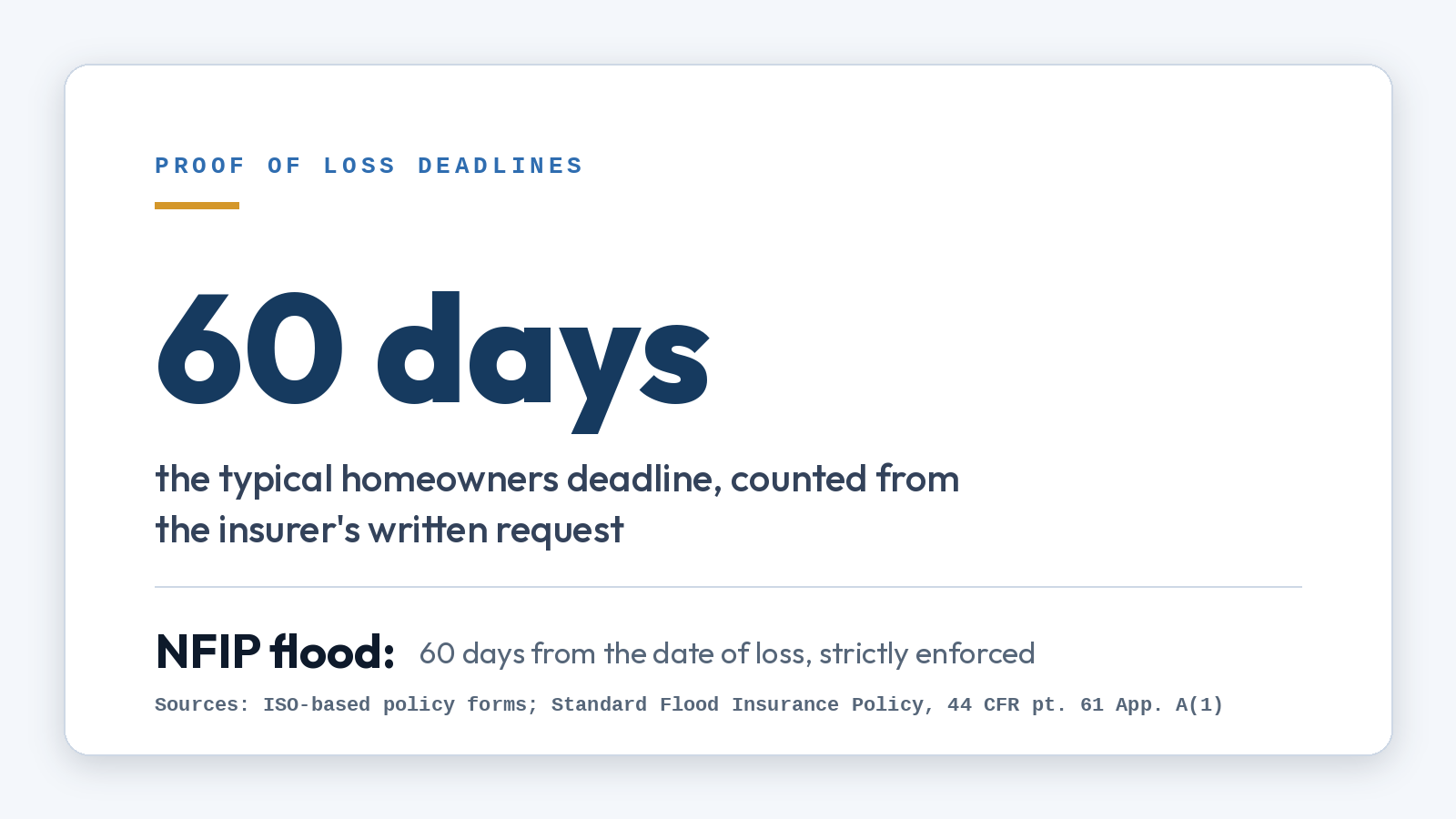
Under most standard homeowners policies, the proof of loss is due within 60 days after the insurer requests it in writing, and blowing the deadline gives the carrier a coverage defense. The 60-day clock in ISO-based forms generally runs from the insurer's request, not the date of loss, as summarized in practitioner guides to policyholder duties after a loss. Your own policy's "Duties After Loss" section controls; some carriers and states use different triggers.
Missing the deadline is serious but, for non-flood claims in Florida, not always fatal. Florida courts often analyze a late or missing proof of loss through the lens of prejudice: did the failure actually impair the insurer's investigation? A late submission creates real legal risk and shifts burdens in litigation even where it does not automatically void coverage. If you cannot complete the valuation in time, ask the carrier in writing for an extension before the deadline passes, and keep proof that you asked.
How the proof of loss interacts with Florida's claim timelines
The proof of loss also starts clocks that run against the insurer. Under Fla. Stat. § 627.70131, a residential property insurer must acknowledge your claim communication within 7 calendar days, begin its investigation within 7 days after receiving proof-of-loss statements, conduct any physical inspection within 30 days after receiving those statements, and pay or deny the claim within 60 days after receiving notice of it, with statutory interest on late payments. A complete, well-documented proof of loss is not just a burden on you; it obligates the carrier to move.
Separate and much bigger clocks apply to the claim itself. Under Fla. Stat. § 627.70132, for policies effective on or after December 16, 2022, you generally have 1 year from the date of loss to give notice of a new claim and 18 months for a supplemental claim. If you find additional covered damage after swearing to an amount, that supplemental window, backed by an amended proof of loss, is usually the mechanism for claiming it. Our guide to Florida claim deadlines collects all of these dates.
| Clock | Trigger | Length | Source |
|---|---|---|---|
| Proof of loss (typical HO policy) | Insurer's written request | 60 days | Policy "Duties After Loss" |
| Proof of loss (NFIP flood) | Date of loss | 60 days unless FEMA extends | SFIP, 44 CFR pt. 61 App. A(1) |
| Insurer begins investigation | Receipt of proof-of-loss statements | 7 days | § 627.70131 |
| Insurer pays or denies | Notice of claim | 60 days | § 627.70131 |
| New claim notice (FL) | Date of loss | 1 year | § 627.70132 |
| Supplemental claim (FL) | Date of loss | 18 months | § 627.70132 |
What are the proof of loss rules for NFIP flood claims?
Flood claims under the National Flood Insurance Program follow a stricter rule: the Standard Flood Insurance Policy requires you to send a signed and sworn proof of loss within 60 days after the date of loss, not 60 days after a request. Because the SFIP is a federal regulation, courts enforce its terms strictly, and failure to file a timely, compliant proof of loss is routinely upheld as a valid basis for denial. The policy itself calls the flood adjuster's help with the paperwork "a matter of courtesy only"; the obligation stays on you.
FEMA can extend the deadline after major events, but only by formal action. After Hurricane Helene, FEMA extended the proof of loss deadline to 180 days from the date of loss, with a parallel extension for Hurricane Milton. Those bulletins are event-specific; unless your loss is covered by a current written extension, assume the 60-day rule applies. FEMA publishes the NFIP Claims Handbook and the proof of loss form itself.
Three flood-specific traps we want every policyholder to know:
- The adjuster's estimate is not your proof of loss. Signing the flood adjuster's worksheet does not satisfy the requirement unless a compliant, sworn proof of loss in your claimed amount is submitted within the deadline.
- Waiting on the carrier does not stop the clock. Slow inspections and pending engineer reports do not extend the 60 days. If the valuation is incomplete, file for the documented amount and amend later.
- Underclaiming locks you in. Courts have limited NFIP recoveries to amounts supported by a timely sworn proof of loss, so a lowball early number can cap the claim.
If your property took both wind and flood damage, you may be juggling two policies, two proof of loss regimes, and two sets of deadlines at once. That coordination work is exactly what our hurricane damage claims practice covers.
What mistakes on a proof of loss hurt claims?
The damaging mistakes all flow from one fact: the document is sworn, so errors are statements under oath that can be quoted back to you. The failure modes we see most:
- Guessing at the amount. A sworn figure with no estimate, inventory, or invoices behind it invites an examination under oath and gives the carrier's counsel a soft target.
- Understating the loss to "seem reasonable." A low sworn number anchors every later negotiation, and on federal flood claims it can effectively cap recovery. Claim what the documentation supports.
- Signing the carrier-prepared number without checking it. Once you swear to the adjuster's pre-filled number, arguing later that the real loss is higher means contradicting your own sworn statement. Compare their scope line by line against your contractor's first.
- Inconsistencies across documents. The proof of loss, your recorded statement, your estimates, and any EUO testimony will be read side by side. Dates, cause, and amounts need to match or be explainable; contradictions feed concealment and misrepresentation defenses.
- Blowing the deadline silently. Missing the date without a written extension request converts a paperwork task into a coverage fight.
- Leaving required fields blank. Courts have treated incomplete proofs of loss as noncompliant, particularly on NFIP claims where strict compliance is the rule. Complete every field or mark it not applicable.
Standard policies contain a concealment-or-fraud condition voiding coverage for material misstatements. The fix for uncertainty is documentation and, where something is genuinely unknown, saying so on the form, never inventing precision you do not have.
Pro Tip: Keep a copy of everything you submit and send the proof of loss by a method that produces a delivery record, then confirm receipt in writing.
Should you get help before signing a proof of loss?
Getting qualified help before you sign is reasonable: you are executing a sworn legal document that fixes your claim position, usually while displaced, repairing, and negotiating. Who can help:
- A licensed public adjuster documents and values the loss, prepares the estimate and inventory the sworn amount rests on, and presents the claim. Florida public adjusters are licensed under Fla. Stat. § 626.854, which also lets you cancel a public adjuster contract within 10 days of signing, or within 30 days after the date of loss (whichever is longer) for claims from a declared state of emergency. Start with what a public adjuster is and how one differs from the insurance company's adjuster.
- An attorney matters when coverage has been denied, fraud is being alleged, or an examination under oath is scheduled.
- Your contractor cannot prepare your claim, but a detailed, code-referenced repair estimate is the backbone of a defensible sworn amount.
In South Carolina, public adjusters are governed by S.C. Code Ann. Title 38, Chapter 92, which requires a written contract before work begins and gives the policyholder a five-business-day right to cancel. South Carolina policyholders also generally face a 3-year limitation period for contract actions under S.C. Code Ann. § 15-3-530, so a disputed proof of loss there still sits inside a hard suit deadline.
The core value of help before signing is simple: the sworn number gets built from a defensible scope instead of from pressure and guesswork. A proof of loss that already reflects the full documented loss puts the supplement process and any later appraisal or suit on solid ground.
This article is general information, not legal advice; coverage always depends on your policy language and the facts of your claim.
Key Takeaways
| Point | Details |
|---|---|
| A proof of loss is sworn | Your signed, notarized statement of the amount claimed; distinct from the notice of claim and any estimate. |
| Typical homeowners deadline | 60 days from the insurer's written request under standard "Duties After Loss" conditions; check your policy's wording. |
| NFIP flood is strict | Due 60 days from the date of loss under the SFIP; enforced unless FEMA formally extends (Helene and Milton got 180 days). |
| It starts insurer clocks too | In Florida the insurer must investigate within 7 days and inspect within 30 days of receiving proof-of-loss statements, and pay or deny within 60 days of claim notice (§ 627.70131). |
| Errors are sworn errors | Guessed, understated, or inconsistent figures feed misrepresentation defenses and anchor negotiations low. |
| Supplements exist | Florida's § 627.70132 allows supplemental claims up to 18 months from the date of loss, supported by an amended proof of loss. |
What we see in the field
We rarely see a proof of loss demand arrive on an easy claim. Carriers tend to send them when the file is large, contested, or headed toward an examination under oath, usually with no explanation of what the document means. Homeowners read "sworn statement" and either freeze, missing the deadline, or panic-sign whatever number is easiest. Both reactions cost money.
The pre-filled proof of loss is the pattern we flag most: a form already populated with the carrier's estimate figure, presented as the fast way to get paid. Sometimes the number is fair. Often the scope behind it is missing trades, code items, or entire rooms, and the homeowner has just sworn to it. Unwinding a signed proof of loss is far harder than taking a week to verify the scope first.
On flood claims the danger reverses: not signing too fast but filing too late or too low. The SFIP deadline runs from the date of loss whether or not the adjuster has finished, and we have watched policyholders wait politely for reports while the clock ran. The discipline that works is filing for what you can prove now and amending as documentation matures. Consistency is the through-line: files where every document tells the same story get paid with less friction; files with a sworn number nobody can trace get EUO notices.
- The Vanguard field team
How Vanguard Claims Solutions helps
If an insurer has demanded a sworn proof of loss, Vanguard Claims Solutions can step in before you sign: we document the full loss, build the line-item valuation the sworn amount rests on, submit the proof of loss on time, and manage the claim through payment, supplement, or appraisal. The claim review is free, there are no upfront fees, and we work on contingency: no recovery, no fee, with the fee for your claim set out in the written contingency agreement before you sign. Vanguard is licensed in Florida and South Carolina (Andrew Pichardo, FL Public Adjuster License #W493213, SC License #18873906). Call (305) 336-3302 or request your free claim review.
FAQ
Does a proof of loss have to be notarized?
Usually, yes. Most proof of loss forms include a jurat, the notary block that makes the statement "sworn." Check the form your carrier sent; if it includes a notarization block, an unsworn signature may be treated as noncompliant.
Can I change a proof of loss after I submit it?
You can generally submit an amended or supplemental proof of loss when documentation improves or additional damage is found; in Florida, supplemental claims are allowed up to 18 months from the date of loss under § 627.70132. The original sworn statement does not disappear, though, so the first filing should be accurate for what was known at the time.
Who is responsible for filling out the proof of loss form?
You are. Even when a carrier's adjuster offers to prepare it, the policy places the duty on the policyholder, and the SFIP calls adjuster assistance a courtesy only. A licensed public adjuster or attorney can prepare the valuation and the form, but the oath and signature are yours.
Is a proof of loss required on every insurance claim?
No. Many routine claims settle without the insurer ever demanding one. Standard homeowners policies make the sworn proof of loss a duty that arises on the insurer's request, while NFIP flood policies require it on every claim within the deadline. If in doubt, confirm in writing whether the carrier requires one.
What should I do if the deadline is tomorrow and my valuation is not finished?
Submit the best documented proof of loss you can for the amounts you can support, note that additional damages are being documented, and request a written extension at the same time. A timely filing for a provable amount, later amended, beats a blown deadline or a sworn guess.
Recommended
Dealing with this claim right now?
A licensed adjuster will review your loss and policy for free, with no obligation.