What Is Moisture Mapping? Why It Can Make or Break a Water Damage Claim
Water rarely stays where you can see it. Moisture mapping is how professionals prove where it actually went, and that proof often decides how your insurance claim gets paid.
TL;DR:
- Moisture mapping is a systematic survey that measures and records moisture levels in building materials after a water intrusion, plotted on a floor plan and updated daily as drying progresses.
- Pros use pin and pinless moisture meters, thermal cameras, and thermo-hygrometers, comparing readings against a "dry standard" taken from unaffected materials.
- For your claim, the map is evidence. It proves the scope of damage, supports the drying invoice, and helps establish the loss was sudden rather than gradual.
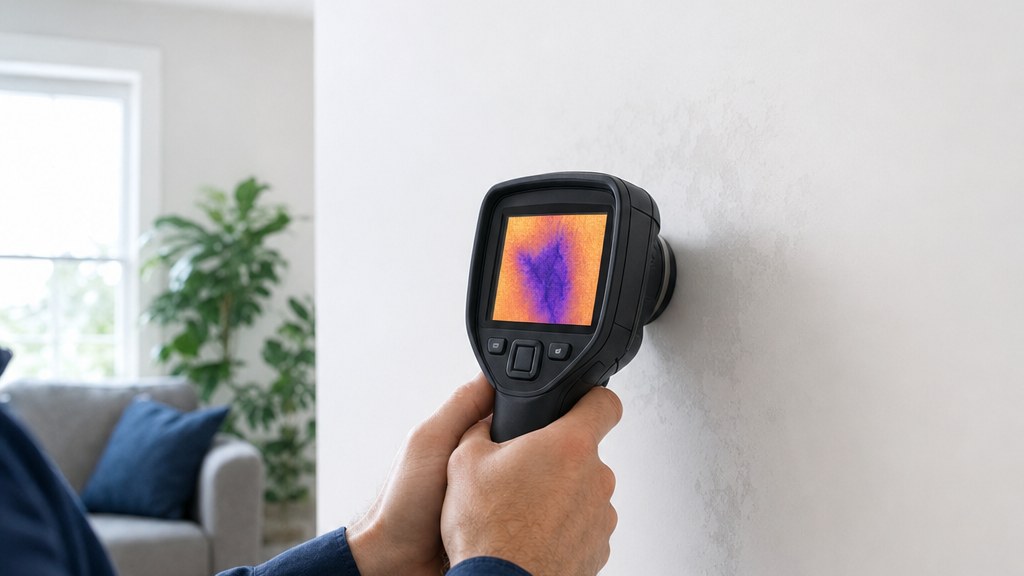
- Thermal cameras see temperature, not water. Every thermal finding should be confirmed with a moisture meter.
- The EPA advises drying wet materials within 24-48 hours to prevent mold, so mapping and drying must start fast.
Moisture mapping is the systematic process of measuring moisture levels across a building's materials after water intrusion, recording the readings on a floor plan, and repeating the measurements over time until everything is verifiably dry. A technician tests drywall, flooring, framing, and cabinetry room by room with meters and a thermal camera, so anyone reviewing the file can see where water traveled and how saturated each material was on each day.
The map is not just a drying tool. It becomes the core documentation of your water damage claim: the objective record an insurer can accept, dispute, or quietly underpay against. When the map is thorough, the claim scope is hard to argue with. When it is thin or missing, the estimate tends to shrink to what was visible in photos. That gap between visible and actual damage is where firms like Vanguard Claims Solutions spend most of their time.
What is moisture mapping, exactly?
Moisture mapping is a documented survey of how wet a building really is, not a guess based on what looks wet. SERVPRO describes it as "creating a detailed guide that shows the restoration team exactly where water has traveled and how much of it is hiding from sight." The key word is hiding. Water wicks up drywall, runs along top plates, and soaks insulation inside wall cavities; a room can look fine at eye level while the bottom two feet of the wall are saturated.
A proper moisture map has three defining features:
- It is measured, not eyeballed. Every affected material gets a numeric meter reading, not a note that says "wet."
- It is compared against a baseline. Technicians meter identical, unaffected materials elsewhere in the building to establish a dry standard; Tramex, a moisture meter manufacturer, explains that these baselines separate abnormally wet from normal and set a "drying goal" per material.
- It is repeated over time. Conditions are tested "at the beginning, during and at the end of the drying process." One reading proves a moment; a series proves a drying event.
The playbook behind all of this is the ANSI/IICRC S500 Standard for Professional Water Damage Restoration, currently in its fifth edition (2021). S500 is the consensus standard restoration contractors follow, and the reference carriers' consultants use when they audit a drying job. S500 classifies every water loss two ways, and both end up on the map:
- Category (contamination). Category 1 is clean water from a sanitary source like a supply line. Category 2, gray water, "contains significant contamination." Category 3, black water, "can contain pathogenic, toxigenic, or other harmful agents" and includes sewage backups and outside flooding. Category drives what can be dried in place versus removed, and clean water does not stay clean: Category 1 can degrade to Category 2 within 48-72 hours if it sits.
- Class (evaporation load). Class 1 is minimal water in part of a room. Class 2 involves whole rooms with saturated carpet and pad. Class 3 is worst-case saturation, often from overhead. Class 4 covers water bound in low-porosity materials like hardwood, plaster, and concrete, which can need specialty drying measured in weeks.
How is a moisture map created?
A moisture map is built with a small toolkit of instruments, each covering the others' blind spots.
| Tool | What it measures | Strengths | Limits |
|---|---|---|---|
| Pin moisture meter | Electrical resistance between two inserted pins | Precise reading at a known depth | Leaves pin holes; tests one spot at a time |
| Pinless moisture meter | Electromagnetic signal scanned through the surface | Fast, damage-free surveys of large areas | Needs a flat surface; surface moisture can skew readings |
| Thermal imaging camera | Surface temperature differences | Rapidly reveals suspect cool patterns | Sees temperature, not water; must be confirmed with a meter |
| Thermo-hygrometer | Air temperature and relative humidity | Tracks the drying environment | Says nothing about moisture inside materials |
Pin vs. pinless moisture meters
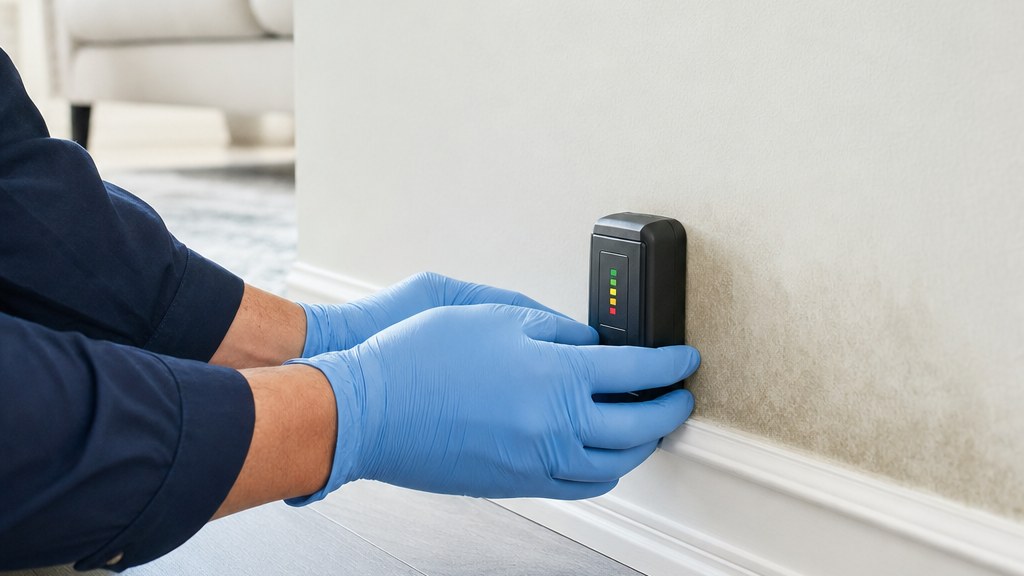
Pin meters work on electrical resistance: current flows between two probes pushed into the material, and because water conducts electricity, wetter material shows less resistance. Wagner Meters explains that pin meters read at the exact depth the pins are inserted, ideal for pinpointing how deep moisture has penetrated, at the cost of small holes and one test spot at a time. Pinless meters instead "emit electromagnetic signals to measure the moisture content" through a flat sensor pad, scanning roughly 1/4 or 3/4 inch deep depending on the model. They sweep a large wall in seconds without damage, so technicians scan broadly with a pinless meter to find wet zones, then verify with pins.
Thermal imaging: powerful, and commonly misunderstood
Thermal cameras look impressive in a claim file, but FLIR, the leading thermal camera maker, is blunt about their limits: "A thermal imaging camera cannot 'see' moisture in walls, but it can detect subtle temperature differences and patterns that reveal the existence of water." Wet materials usually read cooler because evaporation pulls heat from the surface.
But cold patterns have other causes: air leaks, missing insulation, HVAC ducts. FLIR's guidance is that "you should always use a moisture meter to confirm what the thermal camera has detected." A thermal image without confirming meter readings is a lead, not evidence, and insurers' consultants will challenge a report that relies on imagery alone.
Psychrometry and the daily drying log
The third leg of the map is the air itself. Drying works by moving moisture out of materials into the air, then out of the air with dehumidifiers, so technicians log temperature and relative humidity daily with thermo-hygrometers. These psychrometric readings prove the drying setup was working. The EPA recommends indoor relative humidity below 60 percent, ideally 30 to 50 percent, and the logs show whether the environment ever got there.
The full cycle: mark the wet boundary on a floor plan, establish the dry standard and drying goals, install equipment sized to the loss, then return daily to re-meter the same points (SERVPRO notes technicians take new readings daily through a typical three-to-five-day dry-out) until every material hits its goal.
Pro Tip: Ask your restoration company on day one for a copy of the full moisture map and daily drying logs, not just the invoice; you want that documentation in hand before the file gets archived.
Why does moisture mapping matter for your insurance claim?
Moisture mapping matters because it converts an argument about opinions into an argument about recorded measurements. Four fights come up over and over in water claims, and the map is decisive in all of them.
1. It proves the real scope of damage. Estimates get written from what can be documented. If water wicked four feet up a wall but the photos only show a stain near the baseboard, the estimate may cover a cut-and-patch repair instead of the drywall, insulation, and cabinetry that actually got wet. Dated meter readings on a floor plan establish the wet boundary in a way photographs cannot. This is exactly the gap a public adjuster looks for when comparing an insurer's scope against the drying contractor's map.
2. It supports the sudden-versus-gradual fight. Homeowners policies generally cover water damage that is sudden and accidental, while gradual leaks are usually excluded. A moisture map is time-stamped physical evidence: a sharp wet-to-dry boundary and readings consistent with a single recent release of water support "sudden," while insurers use signs of long-term exposure to argue the loss built up over months. The map cuts both ways, which is why you want it done early and done well.
3. It backs up the drying invoice. Mitigation bills are itemized by days of equipment runtime and area treated. Carriers audit these invoices against S500 expectations, and the daily logs are the proof that three air movers ran four days because the readings said the wall was still wet. No logs, and the carrier has an opening to slash equipment days off the bill, leaving you in the middle between insurer and restoration company. Our water damage claims page covers how these disputes unfold.
4. It contradicts lowball scopes and supports supplements. When an insurer's estimate misses rooms or materials the map shows were wet, the map is the rebuttal, and it is the foundation for a supplemental claim when damage surfaces later. In Florida the timing is unforgiving: for policies effective on or after December 16, 2022, Fla. Stat. § 627.70132 generally gives you 1 year from the date of loss to report a new claim and 18 months for a supplemental claim. Florida also holds insurers to their own clock: under Fla. Stat. § 627.70131, a carrier must acknowledge claim communications within 7 days, inspect within 30 days of receiving your proof of loss, and pay or deny within 60 days of notice. In South Carolina, suits on a property claim fall under the 3-year limitations period in S.C. Code Ann. § 15-3-530. See our Florida claim deadlines guide for the full timeline.
What does a professional moisture mapping report include?
A complete moisture mapping report reads like a lab notebook for your house. When we review restoration files, we expect to find:
- A floor plan or sketch of every affected room, marked with the wet boundary and each reading location.
- Loss classification: the S500 category and class, with the reasoning.
- Initial moisture readings for each affected material, alongside dry standard readings from unaffected reference materials.
- Daily monitoring entries: repeat readings at the same points, psychrometric data, and equipment counts and placement.
- Thermal images, each paired with the meter reading that confirmed or ruled out moisture.
- A drying goal per material and a final entry showing each goal was met before equipment removal.
- Photos of the source, the damage, and the equipment setup.
Two red flags: daily entries with identical readings (copy-paste monitoring), and a report that declares the structure "dry" without reference readings, since dry is only meaningful relative to that building's dry standard. If the file you received is thin or contradicts the insurer's estimate, that is an evidence problem worth a professional review before you accept a settlement, especially on a denied or underpaid claim.
Can you do moisture mapping yourself, and when do you need a pro?
You can take useful readings yourself, but a DIY survey supplements professional mapping; it does not replace it in a contested claim. Consumer-grade pinless meters are inexpensive and genuinely helpful for checking whether a small, clean-water spill dried out. If you do it:
- Scan the same spots daily and write down the numbers, with dates and photos.
- Take comparison readings on an identical, unaffected surface in another room.
- Check low on walls and under sinks; water travels down and sideways along framing.
- Do not open walls or pull flooring on a contaminated loss. Category 2 and 3 water carries health risks that call for protective equipment and controlled removal.
Call a professional when the water came from a contaminated source, the area spans multiple rooms or floors, water reached wall cavities, insulation, or hardwood, the property sat wet more than a day, or you intend to file a claim of any real size. An insurer's reviewer gives weight to S500-compliant documentation from calibrated instruments; homeowner meter notes can corroborate a timeline, but they will not carry a scope dispute on their own.
Pro Tip: Even if pros are handling everything, take dated photos and videos on day one, before mitigation starts; the "before" condition is the one piece of evidence that can never be recreated later.
How does moisture mapping intersect with mold prevention and mold sublimits?
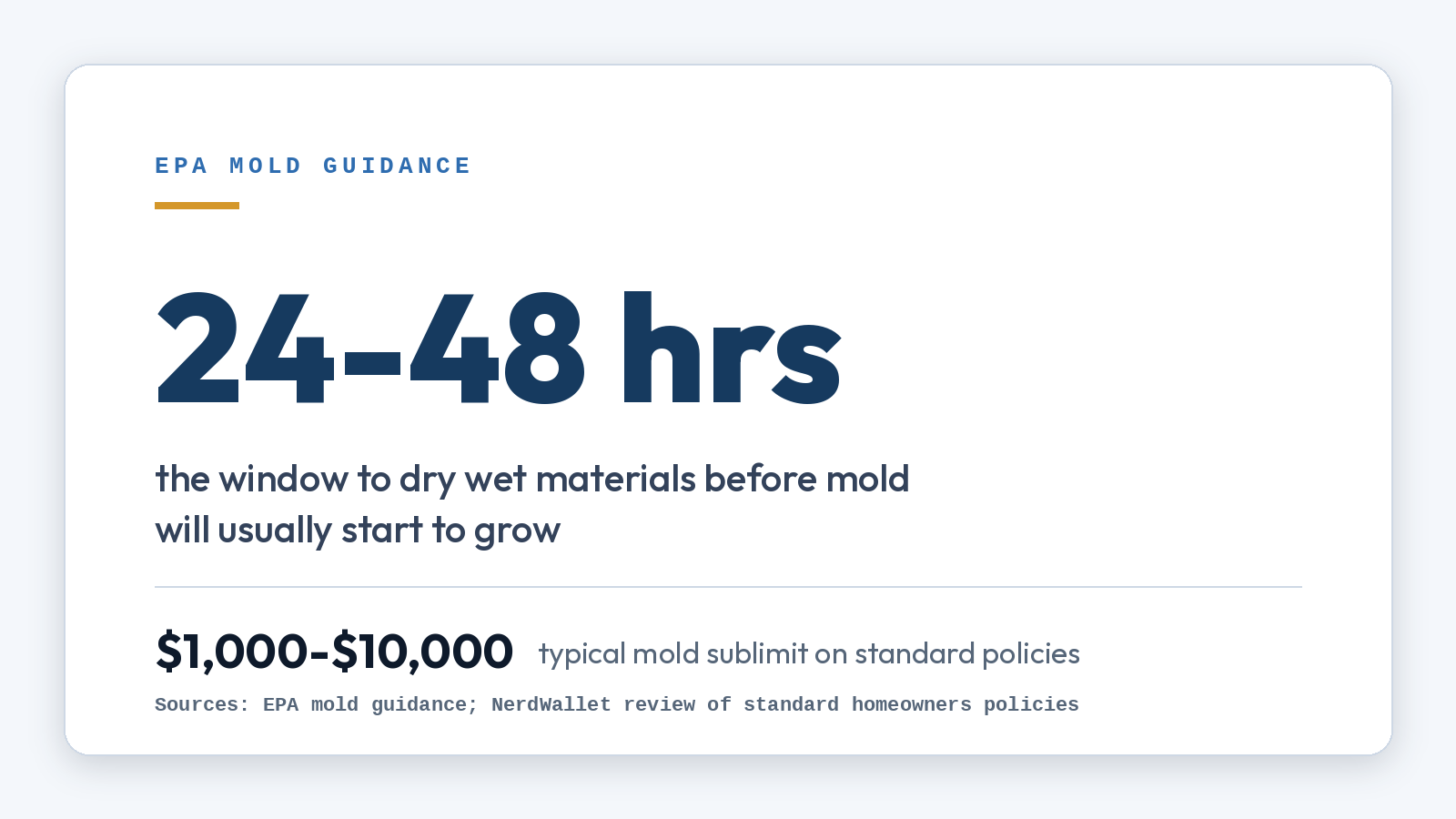
Moisture mapping is your best defense on both the mold itself and the coverage fight that follows it. The EPA's guidance is that "if wet or damp materials or areas are dried 24-48 hours after a leak or spill happens, in most cases mold will not grow." That window is why mitigation speed matters, and why the drying log is such important evidence: it proves whether the structure was dried promptly or moisture lingered for weeks.
The insurance angle is where homeowners get surprised. Mold is typically covered only when it results from a covered, sudden water loss, and even then most policies cap mold-related payouts: NerdWallet's review of standard policies found insurers usually cap mold payouts at $1,000 to $10,000, regardless of your dwelling limit. Check your declarations page for a fungi, wet rot, or bacteria endorsement.
The strategic consequence: if drying was fast and documented, remaining damage is water damage, paid under full policy limits. If drying was slow or undocumented and mold takes hold, the insurer may push much of the loss into the capped mold bucket, or deny it as a maintenance issue. The EPA warns that mold grows hidden on the back side of drywall, above ceiling tiles, and under carpets, places only meters catch early. A thorough moisture map is your strongest tool for keeping a water claim from being reframed as a capped mold claim. If mold has already appeared, see our mold damage claims page.
This section is general information, not legal advice; coverage always depends on your policy language and the facts of your claim.
Key Takeaways
| Point | Details |
|---|---|
| Moisture mapping defined | A repeated, recorded survey of moisture levels in building materials, plotted on a floor plan until drying goals are met |
| The toolkit | Pin and pinless meters, thermal cameras, thermo-hygrometers; thermal findings always verified by meter |
| The standard | ANSI/IICRC S500 (5th edition, 2021): water categories, loss classes, dry standards, daily monitoring |
| Claim leverage | Proves scope, supports sudden-and-accidental causation, backs the drying invoice, rebuts lowball estimates |
| Mold stakes | Drying within the EPA's 24-48 hour window prevents most mold and helps keep claims out of $1,000-$10,000 mold sublimits |
| Deadlines | Florida: 1 year to report, 18 months for supplements (§ 627.70132); insurers pay or deny within 60 days (§ 627.70131). South Carolina: 3-year suit limitation (§ 15-3-530) |
What we see in the field
We read a lot of drying files after the fact, and the most common problem is not fraud or incompetence. It is thin documentation. The crew dried the house perfectly well, but the file contains a handful of photos, one day of readings, and an invoice. Six weeks later the carrier's reviewer cuts equipment days and half the drywall removal because "the documentation does not support it," and the homeowner is caught between a restoration company that wants to be paid and an insurer that will not pay.
The second pattern is the disappearing wet boundary. Water that ran along a top plate or under a floating floor shows up two rooms away, but nobody metered those rooms on day one. When baseboards in the far bedroom start cupping a month later, the insurer treats it as a new, unrelated, possibly gradual loss. A complete initial map, with readings taken beyond the visibly wet area, prevents that argument from ever starting.
Finally, timing. Homeowners often wait to see whether the insurer "will take care of it" before worrying about documentation. By then the equipment is gone, the walls are closed, and the readings that would have proven the claim were never taken. The moisture map has to be built while the building is wet. There is no second chance at that evidence.
- The Vanguard field team
How Vanguard Claims Solutions helps
If you are not sure the documentation, or the insurer's estimate, reflects what actually happened to your property, we can review the file. Vanguard Claims Solutions is a public adjusting firm licensed in Florida and South Carolina, led by Andrew Pichardo (FL Public Adjuster License #W493213, SC License #18873906). We offer a free claim review and work with no upfront fees; the fee for your claim is set out in the written contingency agreement before you sign, and if there is no recovery, there is no fee. Call (305) 336-3302 or reach us through our contact page.
FAQ
Is moisture mapping covered by insurance?
Usually, yes, when it is part of covered water mitigation. Moisture detection and monitoring are standard line items in a drying invoice, and many insurers require moisture documentation with a water damage claim. Coverage still depends on the loss itself being covered under your policy.
How long does moisture mapping take?
The initial survey of an average home takes a few hours, and monitoring continues through the dry-out, which commonly runs three to five days. Dense materials like hardwood, plaster, and concrete (Class 4 losses) can extend drying into weeks.
What moisture meter reading is considered "dry" after water damage?
There is no universal number. Professionals establish a dry standard by metering identical, unaffected materials in the same building, then dry the affected materials until readings return to that baseline. A report that calls a home dry without reference readings is incomplete.
Can a moisture map prove my leak was sudden and not gradual?
It is often the strongest physical evidence on that question. Time-stamped readings, a defined wet boundary, and a documented clean-water source support a sudden loss, which matters because gradual leaks are commonly excluded from coverage. Insurers weigh it alongside plumber findings and the overall timeline.
Should I get moisture mapping even if the damage looks minor?
For anything beyond a small surface spill that dried within a day, yes. Water hides in wall cavities and under flooring, and the EPA's 24-48 hour mold window closes quickly. Skipping documentation on a "minor" loss is how homeowners end up with a mold problem and no evidence tying it to the covered event.
Recommended
Dealing with this claim right now?
A licensed adjuster will review your loss and policy for free, with no obligation.