What Is Recoverable Depreciation? How to Get the Rest of Your Claim Check
Your claim worksheet shows thousands subtracted for "depreciation." Here is what that number means, when you can get it back, and the steps and deadlines that decide whether you ever see the second check.

TL;DR:
- Recoverable depreciation is the part of your claim payment the insurer withholds up front and releases after you repair or replace the property and submit proof.
- It only exists on replacement cost value (RCV) coverage. On an actual cash value (ACV) policy, the deduction is permanent.
- To collect it, finish the work, send invoices and receipts, and request the release in writing before your policy's deadline.
- Policies set time limits; standard homeowners forms require notice of intent to claim replacement cost within 180 days of the loss in some situations.
- In Florida, insurers must pay at least ACV up front on a dwelling claim, then the remaining replacement cost as work is performed; a total loss is paid with no depreciation holdback under Fla. Stat. § 627.7011.
Recoverable depreciation is the difference between the replacement cost of your damaged property and its depreciated (actual cash) value, which your insurer holds back from the first claim check and pays out after you complete the repair or replacement and prove it. That is why your worksheet shows a large deduction labeled "depreciation" even though you bought replacement cost coverage. The insurer is not necessarily refusing to pay that money; it is waiting for evidence you actually spent it on the repairs.
The catch is that the second check does not arrive on its own. You have to complete the work, document it, and request the release inside the time limits buried in your policy conditions, or forfeit money you were owed. This guide covers the mechanics, the paperwork, and the Florida rules that change how the holdback works, drawing on what our Vanguard Claims Solutions team sees on worksheets every week.
What is recoverable depreciation?
Recoverable depreciation is the withheld portion of a replacement cost claim: the gap between what it costs to replace your property new today and what the aged version was worth at the moment of loss. Insurers calculate depreciation by assigning the item a useful life and reducing its value for age and wear, as consumer guides from the NAIC and the North Carolina Department of Insurance explain. The NC DOI puts the two-step process plainly: the insurer may first pay the actual cash value, and once the item is repaired or replaced and receipts are submitted, it reimburses the difference.
Recoverable vs. non-recoverable depreciation
Not every depreciation line on your worksheet can be clawed back:
- Recoverable depreciation applies to property covered on a replacement cost basis. Complete the work, prove it, and the insurer owes you the withheld amount up to your policy limits.
- Non-recoverable depreciation applies where the policy only pays actual cash value: ACV-only policies, ACV endorsements (roof payment schedules are the big one), and items excluded from replacement cost treatment. That deduction is permanent no matter what you spend.
Read your declarations page and loss settlement conditions to see which bucket each item falls in. If the worksheet does not say, make the insurer state it in writing.
How do ACV and RCV policies pay differently?
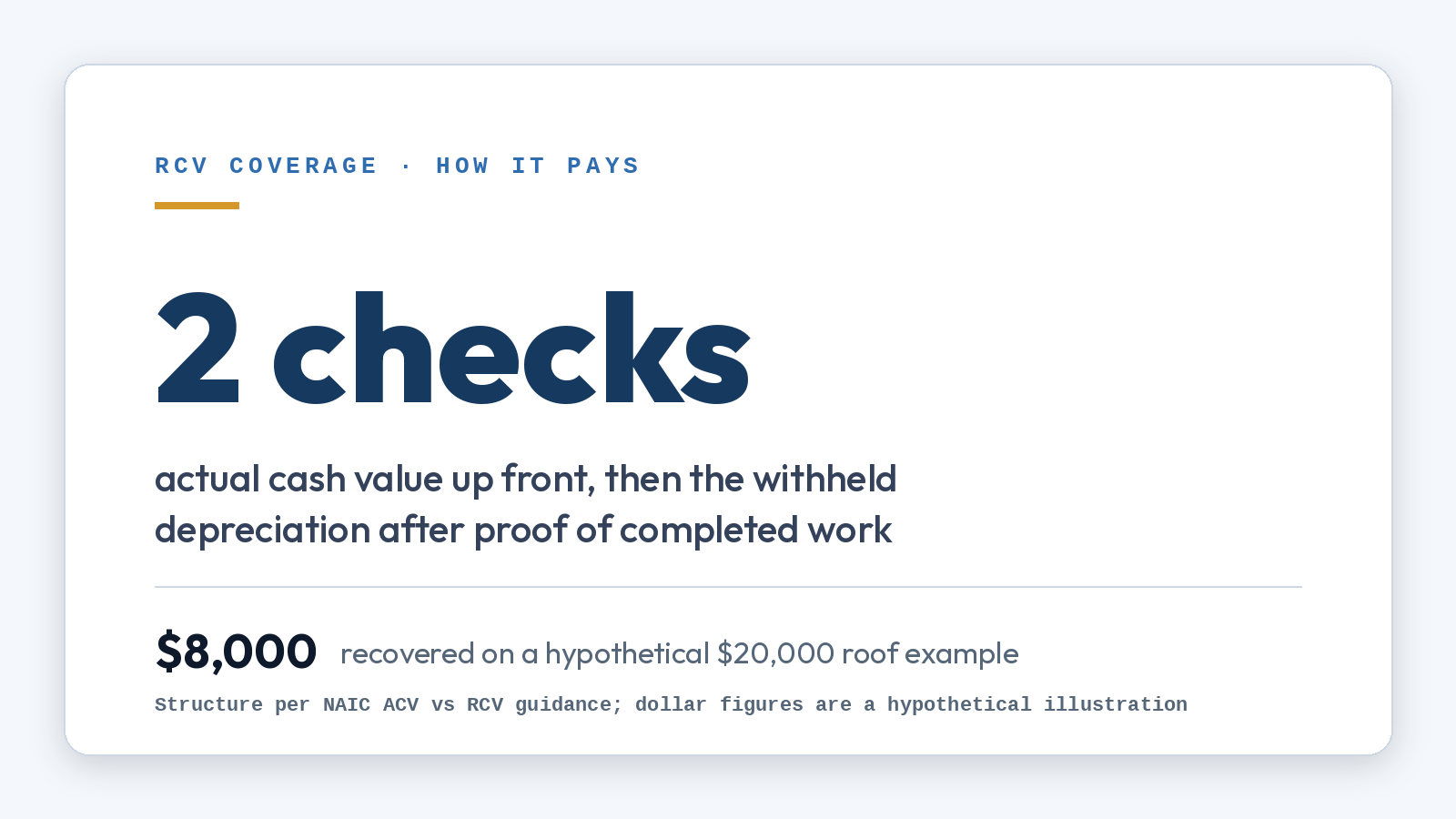
An actual cash value policy pays the depreciated value of your property, once, and you absorb the rest. A replacement cost policy pays in two stages: an up-front payment based on actual cash value, then the withheld depreciation after the work is done. On a $10,000 covered loss, the NAIC notes RCV coverage pays the full repair cost minus your deductible, while ACV coverage reduces the payout for age and condition.
| ACV policy | RCV policy | |
|---|---|---|
| What it pays | Replacement cost minus depreciation | Full cost to repair or replace with like kind and quality |
| Depreciation | Deducted permanently | Withheld, then released after proof of completed work |
| Number of checks | Usually one | Usually two (ACV first, depreciation after) |
| Your job after the first check | None required | Complete repairs, keep invoices, request the release before the deadline |
| Typical use | Older roofs, budget policies, some mobile home policies | Standard homeowners dwelling coverage |
A worked example (hypothetical illustration)
The numbers below are a simplified hypothetical illustration, not a real claim or a promised outcome.
| Line item | Amount |
|---|---|
| Replacement cost of the roof (RCV) | $20,000 |
| Depreciation withheld (age and wear) | -$8,000 |
| Actual cash value (ACV) | $12,000 |
| Your deductible | -$2,000 |
| First check (ACV payment) | $10,000 |
| Second check after completed repairs (recoverable depreciation) | $8,000 |
If the roof is covered at replacement cost, you ultimately collect $18,000 of the $20,000 job, and your deductible is the only planned out-of-pocket cost. If the same roof were covered on an ACV basis, the $8,000 would never be paid, and you would be $10,000 out of pocket for the identical loss. Roofs take the heaviest depreciation because it is driven by age against an assumed useful life, so a 15-year-old shingle roof can lose a large share of its paper value even though it worked fine the day before the storm. If your roof worksheet looks thin, see our roof damage claims page.
How do you actually claim recoverable depreciation, step by step?
You claim recoverable depreciation by completing the covered repairs, sending proof of the work and its cost, and requesting the withheld funds in writing before your policy deadline. The sequence that works:
- Confirm the holdback on paper. Get the insurer's full estimate and payment worksheet, and identify every withheld depreciation line and whether it is marked recoverable. If it is not broken out, request an itemized version.
- Verify the scope before work starts. The release is tied to the insurer's approved scope. If your contractor finds additional damage mid-job, report it as a supplement before the work covers it up. Our supplement service exists because this step is skipped so often.
- Complete the repair or replacement. Insurers release depreciation on completed work, documented with detailed records of labor, materials, and payments; some also want photos, a contractor's certificate of completion, or an inspection (Insurify).
- Assemble the proof package. Signed contract, itemized final invoice, proof of payment, before-and-after photos, and permits or inspection sign-offs where required.
- Request the release in writing. Send the package with a short letter referencing your claim number, stating the approved scope is complete, and requesting the withheld depreciation. Email creates a timestamp; use it.
- Follow up on the insurer's clock. In Florida, your request starts statutory claim-handling deadlines, covered below. If weeks pass in silence, escalate in writing.
Pro Tip: Send your depreciation release request the same week the job finishes, while the contractor's file, photos, and permit records are easy to pull and policy deadlines are still far away.
If your final invoice comes in below the insurer's replacement cost estimate, expect the release to be capped at what you actually spent. If it comes in higher, that is a supplement conversation, not a cost you eat.
What deadlines and paperwork trip people up?
Homeowners most often lose recoverable depreciation by blowing a time limit they never knew existed. Three clocks can run at once:
- The policy's replacement cost conditions. The standard ISO Homeowners 3 (HO-3) form lets you take an actual cash value settlement first and then claim the additional replacement cost amount, "provided you notify us of your intent to do so within 180 days after the date of loss," per the policy language analyzed by the Property Insurance Coverage Law Blog. That clause requires notice of intent within 180 days, not completed construction, but do not test it: put your intent in writing early.
- Repair-completion time frames. Some carriers and policy forms require the repairs themselves to be completed within a set window, such as 180 days or six months, and missing it can forfeit the withheld depreciation even if you finish the work later (Insurify). The window depends on your policy terms and state law, so read your loss settlement conditions.
- Statutory claim deadlines. In Florida, for policies effective on or after December 16, 2022, you generally have 1 year from the date of loss to give notice of a new claim and 18 months for a supplemental claim under Fla. Stat. § 627.70132. A release request on an open claim is not a new claim, but added scope discovered during repairs must land inside the supplemental window. Our Florida claim deadlines guide maps these dates.
South Carolina homeowners should treat the policy's own proof and time-limit conditions as controlling, and know that a lawsuit over a property claim generally must be filed within three years under S.C. Code § 15-3-530. South Carolina public adjusters are licensed under S.C. Code Title 38, Chapter 92.
On paperwork, the two recurring failures are proof of payment and mortgage endorsements. Insurers want evidence you actually paid for the work, not just an invoice: canceled checks, card statements, or the financing agreement. And with a mortgage, claim checks are usually payable to you and your lender jointly; the lender's endorsement process has its own inspection and disbursement rules, so start it early.
Pro Tip: Before signing a restoration contract, confirm the contractor will produce an itemized final invoice matching the carrier's estimate line codes, because a lump-sum one-line invoice is the most common reason depreciation releases stall.
What does Florida law say about depreciation holdbacks on your home?
Florida law limits how insurers can hold back money on dwelling claims. Under Fla. Stat. § 627.7011, when you have replacement cost coverage on a dwelling:
- Total loss: the insurer "must pay the replacement cost coverage without reservation or holdback of any depreciation in value." If the home is a total loss, there is no depreciation game at all.
- Partial loss: the insurer must initially pay at least the actual cash value of the loss, minus your deductible, and then "shall pay any remaining amounts necessary to perform such repairs as work is performed and expenses are incurred." In plain terms, you do not have to finish and fully fund the whole project before the rest of the money flows; the insurer owes the remaining replacement cost progressively as the work happens.
- Roof deductible exception: if your policy carries a separate roof deductible, the insurer may limit the roof payment to actual cash value until you provide reasonable proof you paid that deductible, such as a canceled check or credit card statement.
Florida also puts the insurer on a clock. Under Fla. Stat. § 627.70131, the insurer must acknowledge claim communications within 7 calendar days, begin its investigation within 7 days of receiving proof-of-loss statements, and pay or deny the claim (or a portion of it) within 60 days of notice, with a written explanation, absent factors beyond its control. Those timelines cover supplemental and reopened claims too, which is leverage when a release request sits unanswered.
One more Florida wrinkle relevant to roof math: the "25% roof rule" changed in 2022. Under Fla. Stat. § 553.844(5), if a roof was built or replaced in compliance with the 2007 Florida Building Code or later, then even when 25% or more of it is being repaired, only the repaired portion must be brought to current code (Jimerson Birr). Repair versus full replacement changes the replacement cost number your depreciation is calculated against, so get the code question answered before accepting any roof estimate.
This section is general information, not legal advice. Coverage always depends on your policy language and the facts of your claim.
What if the insurer refuses to release it or the numbers look wrong?
Start by forcing specificity: make the insurer state in writing which policy condition it relies on to withhold the funds and what documentation is missing. "Still under review" is not a coverage position, and in Florida the 60-day pay-or-deny requirement with a written explanation under § 627.70131 applies.

Then audit the math, because holdback disputes are usually estimate disputes in disguise. The common problems:
- Excessive depreciation percentages. Depreciation should reflect real age, condition, and useful life. A 5-year-old architectural shingle roof depreciated as if it were at end of life is a number to challenge with photos, installation records, and manufacturer lifespan data.
- Depreciated items that should not be depreciated. Some estimates depreciate labor, code-required upgrades, or brand-new components. Whether labor depreciation is even permitted depends on your policy language and state.
- The wrong replacement cost base. If the insurer's RCV is below what any real contractor will do the work for, both checks are built on a bad foundation. That is a supplement and re-estimate fight, not a paperwork fight.
- Recoverable depreciation reclassified as non-recoverable. Demand the policy provision that supports the reclassification, in writing.
If the insurer digs in, the escalation ladder runs from a written dispute with your own documentation, to the policy's appraisal clause, to a regulator complaint, to litigation within the applicable time limits. A licensed public adjuster can rebuild the estimate, document the work to carrier standards, and push the release through, a large part of what our denied and underpaid claims service does.
Key Takeaways
| Point | Details |
|---|---|
| Recoverable depreciation defined | The withheld gap between replacement cost and actual cash value, paid after you prove completed repairs |
| Only on RCV coverage | ACV policies and ACV roof schedules make the deduction permanent |
| It is not automatic | Complete the work, submit invoices and proof of payment, request the release in writing |
| Deadlines decide outcomes | HO-3 180-day notice of intent; some policies set repair-completion windows; Florida sets 1-year/18-month claim notice deadlines |
| Florida limits holdbacks | Total dwelling losses paid with no holdback; partial losses paid at least ACV up front, then as work is performed (Fla. Stat. § 627.7011) |
| Disputed holdbacks are winnable | Challenge inflated depreciation, wrong RCV bases, and unexplained refusals in writing, then escalate |
What we see in the field
We read claim payment worksheets for a living, and the depreciation line is where most homeowners quietly lose money without ever getting a denial letter. Nothing about the first check says "there is more available if you act." It arrives, smaller than the repair bids, and a stressed family assumes that is the settlement. Months later the repair is done on a thinner budget, the policy window has closed, and the withheld amount stays with the carrier. The homeowner never knew there was a second half.
The second pattern is depreciation applied with a heavy thumb: healthy mid-life roofs depreciated near the bottom of their useful-life range, and labor and code items depreciated where the policy does not clearly allow it. Because the ACV check equals RCV minus depreciation minus deductible, every inflated depreciation dollar comes straight out of the up-front money needed to start construction. Challenging those inputs early changes both checks.
The third pattern is documentation mismatch. Carriers estimate in line-item software, and when a contractor's closing invoice is one lump-sum line, the desk adjuster cannot reconcile it against the approved scope, so the file stalls in "additional information needed" limbo. The fix costs nothing: an itemized invoice, proof of payment, photos, and permit sign-offs, sent together with a dated written request. Files packaged that way get released; files that trickle in get re-reviewed.
Last, Florida's pay-as-work-is-performed rule for dwellings is underused. Homeowners let carriers frame the holdback as "finish everything, then we will talk," when the statute contemplates money flowing during the job. Knowing that changes how you schedule a contractor and push back on a stalled release.
- The Vanguard field team
How Vanguard Claims Solutions helps
If your worksheet shows a holdback you do not understand, or a release request has gone quiet, we will review the claim for free. Vanguard Claims Solutions audits the carrier's estimate and depreciation math, documents completed work to carrier standards, and pushes releases and supplements through on the statutory clock. There are no upfront fees, we work on contingency, and the fee for your claim is set out in the written contingency agreement before you sign. Licensed in Florida and South Carolina, led by public adjuster Andrew Pichardo (FL #W493213, SC #18873906). Call (305) 336-3302 or request your free claim review.
FAQ
Can I keep the recoverable depreciation without doing the repairs?
Generally no. The withheld depreciation reimburses completed repair or replacement, so if you never do the work, the insurer keeps it and your settlement stays at actual cash value. If you choose not to repair, confirm in writing what that costs you first.
Do I get recoverable depreciation if I do the work myself?
Usually yes for materials you can document with receipts, but your own labor is often reimbursed at little or nothing since you did not incur a labor expense. Ask the carrier in writing how it handles self-performed work before you start.
Who gets the recoverable depreciation check if I have a mortgage?
Most policies name your mortgage lender on dwelling claim payments, so the check typically arrives payable to you and the lender jointly. The lender releases it under its own loss-draft procedures, which can include inspections, so contact its loss draft department as soon as work is scheduled.
How long does the insurer have to pay the depreciation once I submit proof?
Your policy controls, but in Florida insurers must acknowledge claim communications within 7 days and pay or deny a claim or portion of one within 60 days of notice under Fla. Stat. § 627.70131. If your documented request sits past those marks, escalate in writing.
Is depreciation on my roof always recoverable?
No. If your policy covers the roof at replacement cost, the depreciation is recoverable after completed replacement. If it has an ACV roof endorsement or a payment schedule tied to age and material, some or all of it is non-recoverable, so check your declarations page before budgeting the job.
Recommended
Dealing with this claim right now?
A licensed adjuster will review your loss and policy for free, with no obligation.