Can My Insurance Company Cancel or Drop Me After a Claim?
"If I file, will they drop me?" It is the most common question we hear before a claim, and it stops more valid claims than lowball offers ever will. The honest answer has three parts, and only one of them is scary.

TL;DR:
- Cancellation and nonrenewal are different things. Cancellation ends a policy mid-term and is tightly limited. Nonrenewal simply declines to write you again at expiration and is far easier for a carrier to do.
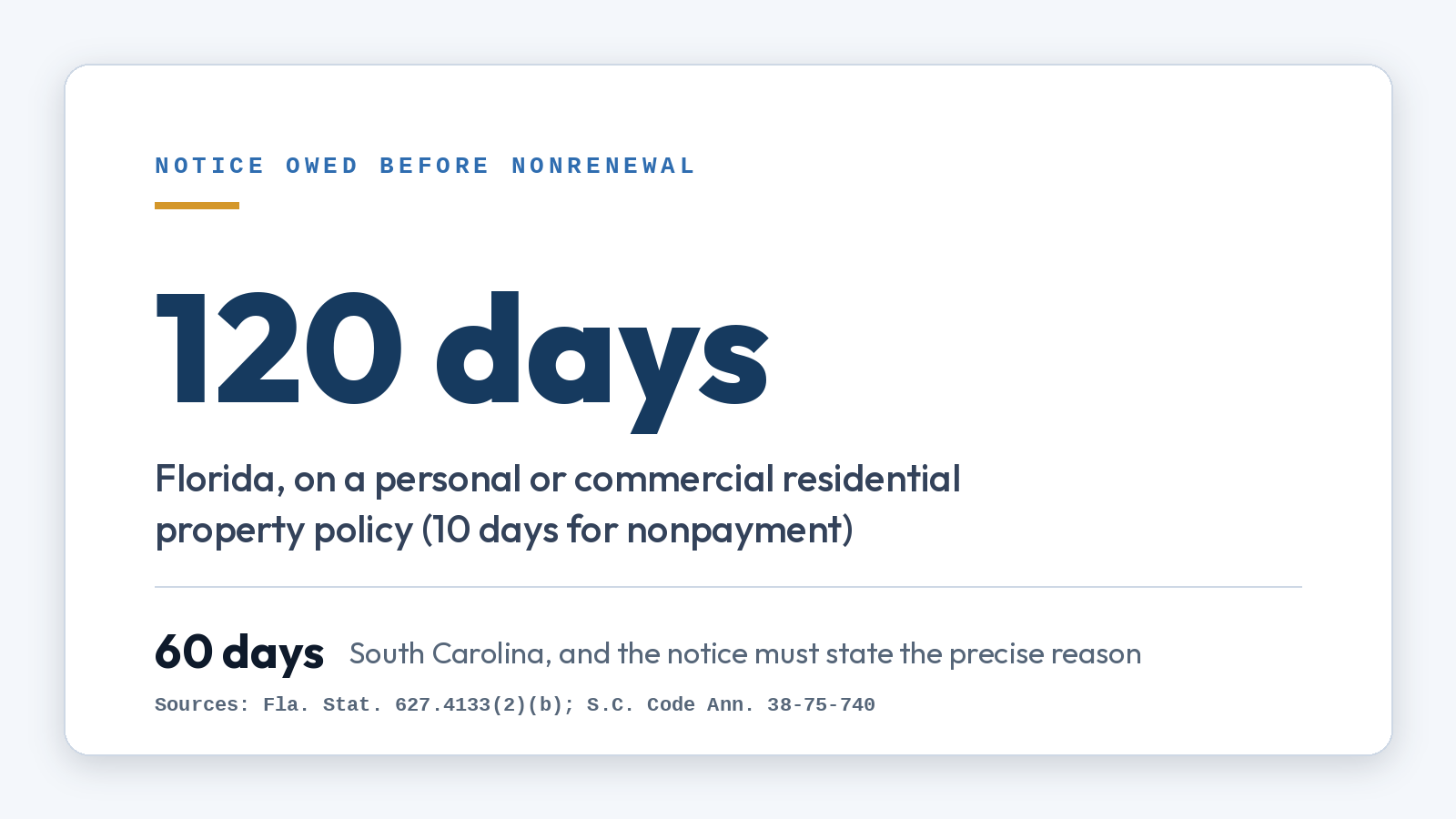
- In Florida, a personal or commercial residential policy generally requires at least 120 days' notice of nonrenewal, cancellation, or termination under Fla. Stat. § 627.4133(2)(b). Nonpayment of premium needs only 10 days.
- Florida bars using an act of God claim as a cause for cancellation or nonrenewal under § 627.4133(3) unless the insurer can show you failed to take reasonable action to prevent recurrence, and bars using a single water damage claim as the sole cause under § 627.4133(6) on comparable terms.
- Florida also blocks cancellation or nonrenewal of a residential property policy for 90 days after hurricane or windstorm damage is repaired, and for up to a year after final payment on other covered perils, under § 627.4133(2)(e).
- In South Carolina, cancellation mid-term requires 30 days' notice (10 for nonpayment) under S.C. Code § 38-75-730, nonrenewal requires 60 days' notice and a stated precise reason under § 38-75-740, and § 38-75-790 prohibits nonrenewing a homeowners policy because the insured filed a claim for damage resulting from an act of God.
- A notice is not the end of the conversation. It has a date, a stated reason, and a set of options, and the reason is frequently something you can fix or dispute.
General information, not legal advice. Read your own policy and your own notice.
Every week someone tells us they are sitting on real, covered damage because they are more afraid of losing the policy than of eating the repair. It is a rational fear in this market. It is also, in most cases, based on a misunderstanding of what an insurer is actually allowed to do, and when.
So let us take it apart properly.
Cancellation and nonrenewal are not the same thing
Homeowners use "dropped" for both. Insurers do not, and the difference decides what protection you have.
| Cancellation | Nonrenewal | |
|---|---|---|
| When it happens | In the middle of the policy term | At the policy's expiration date |
| What it is | The insurer ends a contract it is currently bound to | The insurer declines to offer you a new contract |
| How hard it is | Hard. Limited to a short list of statutory reasons | Comparatively easy. Business reasons are generally allowed |
| Typical notice owed | FL: 45 days (120 for residential property under § 627.4133(2)(b)); SC: 30 days | FL: 120 days for residential property; SC: 60 days |
| Nonpayment shortcut | Yes, 10 days in both states | Not applicable |
The practical takeaway: the mid-term cancellation homeowners picture, the one where a claim gets your policy yanked next week, is the version that almost never happens. What does happen, and what has been happening across Florida and coastal South Carolina for several years, is nonrenewal at the end of the term.
That matters because nonrenewal comes with a long runway. It is not an emergency. It is a shopping deadline.
Can a claim itself get you nonrenewed?
Sometimes, and both states put real limits on it.
Florida
Fla. Stat. § 627.4133 does a few things that matter to a policyholder holding damage and a fear:
- Act of God claims. Subsection (3) provides that claims on property insurance policies which are the result of an act of God may not be used as a cause for cancellation or nonrenewal, unless the insurer can demonstrate, with facts, that the insured failed to take action reasonably necessary to prevent recurrence of the damage.
- A single water damage claim. Subsection (6) provides that one water damage claim may not be used as the sole cause for cancellation or nonrenewal, on comparable conditions.
- A protected window after a storm. Subsection (2)(e) prevents an insurer from cancelling or nonrenewing a personal residential or commercial residential property policy for 90 days after the dwelling has been repaired following hurricane or windstorm damage, and for a period after final payment on other covered perils.
- A long notice period. Subsection (2)(b) requires at least 120 days' notice before the effective date of nonrenewal, cancellation, or termination of a personal or commercial residential property policy, with a 10-day exception for nonpayment of premium.
Read those together and a picture emerges. Filing a hurricane claim on a Florida homeowners policy is not, standing alone, a lawful reason to nonrenew you, and if the carrier does move against the policy you are entitled to four months of warning.
The pressure valve carriers use instead is broader than any single claim: whole books of business get nonrenewed for underwriting and reinsurance reasons, roof age gets tightened, and inspection results drive decisions. Those are not claim retaliation, and they are also not something a homeowner can argue their way out of. They are a shopping problem.
South Carolina
South Carolina's rules sit in Title 38, Chapter 75.
- Cancellation under § 38-75-730 is limited to a defined list: nonpayment of premium, material misrepresentation, a substantial change in the risk, breach of a policy duty or condition, and loss of reinsurance that would imperil the insurer's solvency. Notice must be given not less than 30 days before the proposed effective date, or 10 days for nonpayment.
- Nonrenewal under § 38-75-740 requires written notice to the insured and the agent of record not less than 60 days before the expiration date, and the notice must state the precise reason for the nonrenewal.
- Act of God claims are protected by § 38-75-790, which prohibits an insurer from refusing to renew a homeowners policy because the insured has filed a claim for damages resulting from an act of God.
Two features of the South Carolina scheme are worth a homeowner's attention. First, the notice window is shorter, so a Lowcountry or Upstate homeowner has 60 days rather than four months to line up a replacement policy. Second, the notice must state the precise reason. A vague notice is a defective notice, and the stated reason is the thing you can actually respond to.
South Carolina policyholders with a question about a specific notice can contact the South Carolina Department of Insurance, which handles consumer complaints about cancellations and nonrenewals directly.
What actually drives most nonrenewals right now

In our field work across Florida and South Carolina, the letters we see cluster around a handful of causes, and only some of them involve a claim at all.
- Roof age and condition. By a wide margin the leading trigger. Many carriers will not renew a shingle roof past a certain age without an inspection, a repair, or a replacement, and an inspection photo of a roof in poor condition can trigger a notice by itself.
- Underwriting inspections. The four-point or wind mitigation inspection turns up an old electrical panel, polybutylene plumbing, an unpermitted addition, or a deteriorated roof deck.
- Book-of-business decisions. The carrier exits a county, a ZIP, a property type, or a distance-to-coast band. Nothing about your house changed. This is the most common one that has nothing at all to do with you.
- Claim frequency, not a single claim. Several claims in a short window, especially non-weather water losses, read differently to an underwriter than one hurricane claim does.
- Property condition. Vacancy, deferred maintenance, an unfenced pool, a trampoline, a business run from the home.
- Nonpayment or a payment failure. Often an escrow mix-up after a mortgage transfer rather than a real default. Fixable, and usually fast.
Notice how many of those are conditions rather than verdicts. A roof-age nonrenewal is a repair-or-shop decision. An inspection nonrenewal is often a correct-it-and-request-reconsideration decision. Almost none of them are permanent.
Pro tip: the reason line on the notice is the whole game. Photograph the notice, read the stated reason word for word, and match it to the list above before you do anything else. "Roof condition" and "underwriting guidelines, exit of program" require completely different responses from you.
The claim you are afraid to file has its own cost
We are public adjusters, so treat this as an interested opinion, but it is an informed one.
Not filing does not make the damage disappear. It moves it. Unrepaired water intrusion becomes mold and rotted framing. A compromised roof lets in the next storm. And the next carrier's underwriting inspection, the one you are trying to protect yourself for, will photograph exactly that damage and can decline you over it.
There is also a deadline problem. Florida imposes reporting deadlines that run from the date of loss for property insurance claims, which our Florida claim deadlines guide walks through, and South Carolina claims are bounded by the policy's own contractual suit limitation and the state's three-year statute for suits on a policy, covered in our South Carolina property insurance claims guide. Waiting to see whether the damage gets worse is a strategy that runs out of time.
The honest calculus is not "claim versus no claim." It is: what is the damage actually worth, is it meaningfully above the deductible that applies, and is the loss a covered peril? If it clears those three, the claim is worth filing, and the nonrenewal risk is a shopping problem you can manage on a 60 or 120 day clock.
If it does not clear them, a small claim you file and then withdraw still shows up in the claims history databases carriers pull. That is a real cost, and it is why a free inspection before you file is worth more than any opinion you can get on the internet, ours included.
What to do the day the notice arrives
A cancellation or nonrenewal notice is a document with a deadline. Work it like one.
- Find the effective date and the stated reason. Write both at the top of a page. Every decision below hangs off those two facts.
- Check the notice period. Florida residential property: 120 days for nonrenewal, cancellation, or termination, 10 days for nonpayment. South Carolina: 60 days for nonrenewal, 30 for cancellation, 10 for nonpayment. A notice that gives you less time than the statute requires is a notice worth raising with your agent and, if needed, the state regulator.
- If the reason is nonpayment, call today. This is frequently an escrow or billing error and is often reversible inside the notice window.
- If the reason is a condition, ask what reconsideration requires. Many carriers will withdraw a notice on proof of the repair. Get the requirement in writing, do the work, and send photographs and the invoice.
- Start shopping immediately anyway. Do this even if you expect the notice to be withdrawn. In both states the residual market exists as a backstop: Citizens Property Insurance in Florida and the South Carolina Wind and Hail Underwriting Association for coastal wind and hail, alongside the standard market. Bring your wind mitigation report and any recent roof documentation to every quote; they move price more than anything else you control.
- Do not let an open claim go quiet. A nonrenewal does not extinguish a claim that arose while the policy was in force. The loss was covered when it happened. Keep working the claim on its own track.
- File a complaint if the notice looks wrong. The Florida Department of Financial Services and the South Carolina Department of Insurance both take consumer complaints on cancellation and nonrenewal.
Pro tip: never let coverage lapse for a single day while you shop. A lapse is itself an underwriting flag, it can violate your mortgage terms, and it invites force-placed coverage that costs far more and protects the lender rather than you.
Does a claim raise your premium even if you keep the policy?
Usually, yes, though the mechanism is less personal than homeowners assume.
Property insurance is rated on territory and characteristics far more than on your individual file. In hard markets, the rate increase you see at renewal is mostly reinsurance cost and catastrophe modeling reaching your ZIP code, and it arrives whether you filed or not. A claim can affect your individual rating factors and can affect your claims-free credit, which is a discount you were receiving rather than a penalty being added.
What genuinely moves an underwriter is a pattern: multiple claims in a rolling window, particularly repeated non-weather water losses. One hurricane claim in a hurricane state is an ordinary event. Three water losses in three years is a file.
None of that changes the underlying point. You paid premium for a contract that promised to indemnify a covered loss. Using it as designed is not misconduct.
What we see in the field
The pattern we run into most often is the homeowner who took a small settlement or filed nothing at all after a storm two seasons ago, specifically to protect the policy, and who now has interior damage that traces straight back to the loss they left alone. By then the evidence has degraded, the deadline is close or past, and the carrier's first question is why nothing was reported at the time.
The second pattern is the nonrenewal that arrives with an open claim still unresolved, and the homeowner assumes the claim died with the policy. It did not. The loss occurred during the policy period. We work those claims through to settlement regularly after the policy itself has ended.
The third is the notice nobody read carefully. A stated reason of "roof condition" met with a completed roof repair and photographs has, in our experience, a meaningfully better chance of reconsideration than most homeowners expect, because the underwriter's objection was to a condition, not to the person.
How Vanguard Claims Solutions helps
We are licensed public adjusters, which means we represent policyholders and never insurers. On this particular question we do three things.
Before you file, we inspect at no cost and tell you honestly what the loss looks like: whether the damage is a covered peril, roughly what a proper scope is worth, and whether that number justifies a claim against the deductible that applies. That conversation is the one that prevents the small claim you regret.
During the claim, we document the loss, write the scope, and deal with the carrier so the file is complete and defensible rather than thin.
After a notice, we help you read what actually arrived, keep an open claim moving on its own track regardless of the policy's status, and make sure a nonrenewal is not quietly used as a reason to stop paying what is owed on a loss that happened while the policy was live.
There are no upfront fees and no recovery, no fee. The fee for your claim is set out in the written contingency agreement before you sign anything.
Andrew Pichardo · FL Public Adjuster Lic. #W493213 · SC Public Adjuster License #18873906
Call (305) 336-3302 or request a free claim review.
Key takeaways
| Question | Short answer |
|---|---|
| Can they cancel me mid-term for filing a claim? | Almost never. Both states limit mid-term cancellation to a short statutory list |
| Can they nonrenew me for one hurricane claim? | Florida § 627.4133(3) and South Carolina § 38-75-790 both restrict using an act of God claim that way |
| Can they nonrenew me for one water claim? | Florida § 627.4133(6) bars using a single water damage claim as the sole cause |
| How much warning do I get? | FL residential property: 120 days. SC: 60 days for nonrenewal, 30 for cancellation |
| Does a nonrenewal kill my open claim? | No. A loss covered during the policy period stays covered |
| What actually causes most nonrenewals? | Roof age and condition, inspection findings, and carriers exiting territories |
| First move when the letter arrives? | Read the stated reason, note the effective date, and start shopping the same day |
FAQ
Can my insurance company cancel my policy in the middle of the term because I filed a claim?
Generally no. Mid-term cancellation is limited by statute in both states. South Carolina's § 38-75-730 confines it to nonpayment, material misrepresentation, a substantial change in the risk, breach of a policy duty or condition, and loss of reinsurance imperiling solvency. Florida requires long advance notice for residential property under § 627.4133(2)(b) and restricts the use of act of God claims and a single water damage claim as a cause. Nonrenewal at expiration is the far more common outcome.
How much notice does my insurer have to give me?
In Florida, at least 120 days before the effective date of nonrenewal, cancellation, or termination of a personal or commercial residential property policy, with a 10-day exception for nonpayment of premium. In South Carolina, at least 60 days before expiration for nonrenewal, at least 30 days for a mid-term cancellation, and at least 10 days for nonpayment. South Carolina nonrenewal notices must also state the precise reason.
If my policy is nonrenewed, what happens to a claim I already filed?
The claim survives. Coverage is determined by whether the loss occurred during the policy period, not by whether the policy is still in force when the claim is paid. Keep documenting, keep responding to the carrier, and keep the claim moving on its own timeline.
Will filing a claim raise my premium?
It can affect your individual rating factors and can cost you a claims-free discount. In practice, most of the increase homeowners have seen in Florida and coastal South Carolina over the last several years is driven by reinsurance costs and catastrophe modeling for the territory rather than by any individual file. A pattern of several claims in a short window matters much more to an underwriter than one weather claim.
I got a notice and I think the reason is wrong. What can I do?
Ask your agent for the underwriting basis in writing, correct the condition if it is correctable and submit proof, and file a complaint with the Florida Department of Financial Services or the South Carolina Department of Insurance if the notice appears defective or the stated reason is unsupported. Shop for replacement coverage in parallel rather than waiting for the outcome.
Recommended reading
Dealing with this claim right now?
A licensed adjuster will review your loss and policy for free, with no obligation.