What Is an Insurance Appraisal? The Appraisal Clause Explained
You and your insurer agree the loss is covered. You just disagree, by tens of thousands of dollars, about what it costs to fix. Your policy already contains the tool for that, and most homeowners never know it is there.

TL;DR:
- Appraisal is a contractual process written into most property policies for resolving disputes about the amount of loss, not about whether the loss is covered.
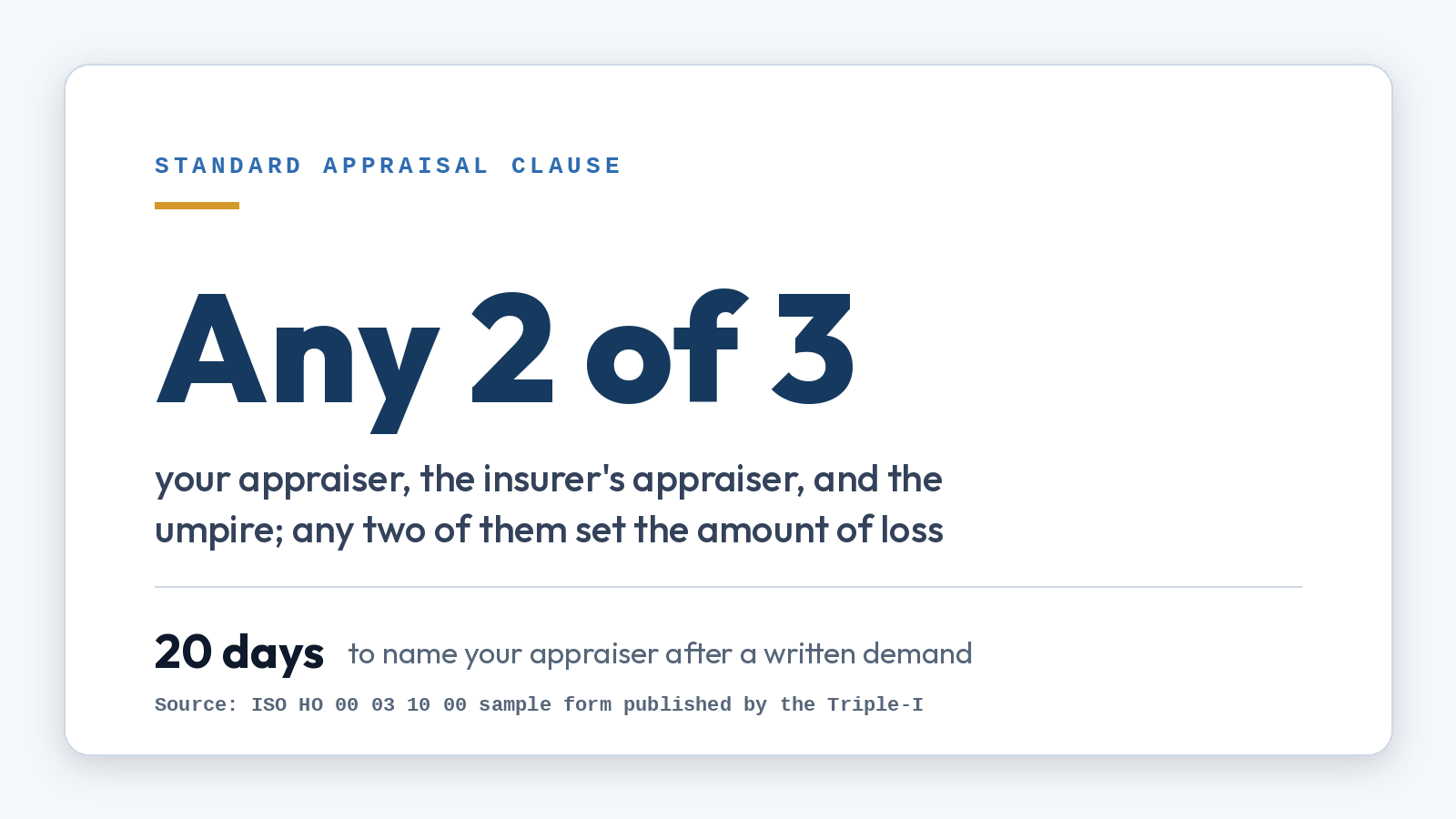
- Each side hires its own appraiser, the two appraisers select an umpire, and the standard clause says "a decision agreed to by any two will set the amount of loss."
- On the standard ISO homeowners form, each party pays its own appraiser and the two "bear the other expenses of the appraisal and umpire equally."
- Appraisal binds the amount. It generally will not fix a denial, a coverage exclusion, or a bad-faith claim-handling dispute.
- Florida offers a free, insurer-funded mediation program as a lighter alternative under Fla. Stat. § 627.7015.
An insurance appraisal is a dispute resolution process built into your property insurance policy that settles disagreements over how much a covered loss is worth. Each side appoints an independent appraiser, those two appraisers pick a neutral umpire, and any two of the three can set a binding amount. It happens outside court, usually costs far less than litigation, and typically resolves in weeks or months rather than years.
It is also widely misunderstood. Appraisal is not an inspection, not a home valuation, and not a general-purpose appeal of everything you dislike about your claim. It answers one question: what is the amount of the loss. Used at the right moment it is the most efficient leverage a policyholder has. Used at the wrong moment it can lock in a number you cannot undo.
What does the appraisal clause actually say?
Most homeowners policies in the United States are built on ISO forms, and the appraisal condition in the widely used HO 00 03 10 00 form published by Triple-I reads as follows:
"If you and we fail to agree on the amount of loss, either may demand an appraisal of the loss. In this event, each party will choose a competent and impartial appraiser within 20 days after receiving a written request from the other. The two appraisers will choose an umpire. If they cannot agree upon an umpire within 15 days, you or we may request that the choice be made by a judge of a court of record in the state where the 'residence premises' is located. The appraisers will separately set the amount of loss. If the appraisers submit a written report of an agreement to us, the amount agreed upon will be the amount of loss. If they fail to agree, they will submit their differences to the umpire. A decision agreed to by any two will set the amount of loss."
Six things are packed into that paragraph, and every one of them matters:
- The trigger is a disagreement about amount, not coverage. "Fail to agree on the amount of loss."
- Either side can demand it. Insurers invoke appraisal too, and often do when they want to cap an escalating claim.
- There are hard clocks. Twenty days to name your appraiser after a written demand, 15 days for the appraisers to agree on an umpire.
- Appraisers must be competent and impartial. Not neutral, but not a rubber stamp either. This wording is the basis for challenging an appraiser who is effectively an employee or has a contingent interest in the outcome.
- A court can appoint the umpire if the appraisers deadlock on the choice.
- Any two of three decide. Your appraiser and the umpire, the insurer's appraiser and the umpire, or the two appraisers agreeing between themselves. That last route resolves a large share of appraisals with the umpire never issuing a decision.
The cost provision follows immediately: each party will "pay its own appraiser" and "bear the other expenses of the appraisal and umpire equally." Read your own policy, though. Carriers modify this clause, and some newer forms add conditions precedent, shorten the windows, or make appraisal available only at the insurer's election.
How does the appraisal process work, step by step?
| Stage | What happens | Typical timing |
|---|---|---|
| Written demand | One party demands appraisal in writing, identifying the dispute over the amount of loss | Day 0 |
| Appraiser selection | Each party names a competent, impartial appraiser | Within 20 days of demand |
| Umpire selection | The two appraisers agree on an umpire, or a court appoints one | 15 days, then court if deadlocked |
| Inspection and exchange | Both appraisers inspect the property and exchange scopes, estimates, photos, and reports | Weeks |
| Negotiation between appraisers | The appraisers attempt to agree on the amount, line by line | Weeks |
| Umpire involvement | If they cannot agree, differences go to the umpire, who reviews and rules | Weeks |
| Award | Signed by any two, setting the amount of loss | Binding on amount |
| Payment | Insurer pays the award less deductible, prior payments, and any applicable depreciation holdback | Per state prompt-payment rules |
The single most important thing to understand about this process is that the two appraisers usually settle it. The umpire exists as a tiebreaker, and the prospect of an unpredictable third party is exactly what motivates two experienced appraisers to close the gap themselves.
The second most important thing: the award sets the amount, not the timing of your money. A replacement cost policy still holds back depreciation until repairs are done, and the award is still reduced by your deductible and anything already paid. If you are not clear on that math, read our explainer on recoverable depreciation before you evaluate a settlement.

Pro Tip: Before demanding appraisal, get a complete copy of the insurer's estimate and compare it line by line against a contractor's estimate for the same scope. If the gap is mostly missing line items rather than pricing, a supplement with better documentation may resolve it faster and cheaper than appraisal.
What can and cannot go to appraisal?
This is where most appraisal fights actually happen, and where policyholders get hurt.
Appraisal decides amount. The cost to repair or replace, the scope of damage required to do it, quantities, unit pricing, and depreciation in most jurisdictions.
Appraisal does not decide coverage. Whether the peril is covered, whether an exclusion applies, whether you complied with policy conditions, whether notice was late, or whether the insurer handled your claim in bad faith. Those are legal questions and they stay legal questions.
The gray area is causation, and it is genuinely gray. When part of the damage came from a covered storm and part from long-term wear, deciding what to pay requires separating the two, which looks like a coverage question and a scope question at the same time. Courts across states have reached different conclusions on how far appraisers may go, and carriers and policyholders both exploit the ambiguity. The practical consequence is that appraisal awards on mixed-causation losses get challenged more often than any other kind.
Note also that carriers commonly reserve rights. An insurer can participate in appraisal and still deny part of the claim afterward on coverage grounds, and the appraisal clause on many forms expressly preserves that. Winning a large award is not the same as being paid it.
This section is general information, not legal advice. How appraisal applies to your claim depends on your policy language, your state's case law, and the facts of your loss.
When should you invoke the appraisal clause?
Appraisal makes sense when four conditions line up:
- Coverage is not in dispute. The insurer accepted the loss. The fight is about the number.
- The gap is meaningful. Appraisal has real costs: your appraiser, half the umpire, and your own time. On a several-thousand-dollar gap that math rarely works. On a gap in the tens of thousands it usually does.
- You have documentation to fight with. An appraiser argues from scope sheets, photos, measurements, moisture readings, engineer reports, and contractor estimates. Without those, appraisal is just two people disagreeing louder.
- Negotiation has genuinely stalled. Not one unsatisfying phone call. A documented supplement submitted, reviewed, and refused.
Reasons to hold off:
- You suspect a coverage denial is coming. Appraisal will not resolve it, and you may spend money establishing an amount that the carrier then declines to pay.
- Your documentation is incomplete. Fix that first. It is far cheaper to improve a supplement than to lose an appraisal.
- The dispute is about claim handling. Delay, lost documents, and repeated reinspections are regulatory and legal issues, not amount-of-loss issues.
- A deadline is close. Appraisal takes months and does not necessarily pause your policy's suit limitation period. Confirm that before you rely on it.
What does an insurance appraisal cost?
Under the standard clause, you pay your appraiser and half the umpire's fee. Appraisers commonly charge either hourly or on a percentage-of-recovery basis depending on state rules and the professional involved, and umpires typically charge hourly or a flat fee. Costs scale with the size and complexity of the loss, and a large commercial appraisal with engineers involved is a different order of expense from a residential roof dispute.
The comparison that matters is not appraisal versus free. It is appraisal versus litigation, and versus accepting the insurer's number. Litigation on a property claim runs on a timeline of years, involves depositions and experts, and in Florida now requires a presuit step before you can even file: under Fla. Stat. § 627.70152, a claimant in a residential or commercial property insurance suit must give written notice at least 10 business days before filing, after the insurer has made its coverage determination, and the insurer then has 10 business days to respond, including by demanding appraisal or another form of alternative dispute resolution.
Pro Tip: Ask any appraiser you interview how many appraisals they have completed, how many went to an umpire, and whether they have served as an umpire themselves. Umpire experience is a strong signal that they know how the deciding party actually evaluates a file.
Appraisal, mediation, or litigation: which one fits?
| Appraisal | Mediation | Litigation | |
|---|---|---|---|
| Decides | Amount of loss only | Whatever the parties agree to | Coverage, amount, bad faith, everything |
| Binding? | Yes, on the amount | No, until a written settlement is signed | Yes |
| Who pays | Each side its appraiser, umpire split | In Florida, the insurer under § 627.7015 | Each side, subject to fee statutes |
| Speed | Weeks to months | Weeks | Months to years |
| Best for | Real, documented gap on an accepted claim | Early, moderate disputes and communication breakdowns | Denials, exclusions, and claim-handling misconduct |
Florida's mediation program deserves attention because it is cheap and underused. Fla. Stat. § 627.7015 establishes a nonadversarial mediation process administered through the Department of Financial Services. Insurers must notify policyholders of their mediation rights at policy issuance and renewal and when a first-party claim is filed. The insurer bears the cost. The process is nonbinding, though a written settlement becomes binding after three business days unless the policyholder rescinds before cashing a check. Claims under $500 are excluded unless both parties agree, as are disputes involving suspected fraud or claims that do not comply with the reporting deadlines in § 627.70132.
In South Carolina, appraisal is likewise contractual, so the clause in your policy controls, and there is no equivalent state-run mediation program for property claims. What South Carolina does offer is an active regulator: the SCDOI Office of Consumer Services takes complaints when you disagree with the denial, amount, or handling of a claim. On the litigation side, suits on a property insurance policy generally fall under the three-year limitations period in S.C. Code Ann. § 15-3-530, but your policy's own notice and proof-of-loss deadlines are usually much shorter and control how quickly you must act. Our South Carolina property insurance claims guide covers the landscape there.
Our appraisal and mediation service page explains how we handle both.
Who should serve as your appraiser?
Your appraiser is not a neutral. The clause requires competence and impartiality, but your appraiser is the one who understands your loss and argues your scope, and appointing the wrong person is the most common self-inflicted wound in appraisal.
What to look for:
- Documented construction and estimating expertise for your specific loss type. Roofing, water mitigation, smoke restoration, and large-loss commercial reconstruction are different skills.
- Appraisal experience specifically. Estimating a repair and defending a scope against another professional are not the same job.
- Independence. An appraiser with a financial stake in performing the repairs invites a challenge to the award.
- Availability. The clocks in the clause are short, and an appraiser who cannot inspect for six weeks stalls the process.
- Licensing. In Florida, public adjusters are licensed under Fla. Stat. § 626.854, and whether a given professional may act as your appraiser or your adjuster depends on the role and the state's rules. Ask directly.
Key Takeaways
| Point | Details |
|---|---|
| What appraisal is | A contractual process for resolving disagreement over the amount of a covered loss, outside of court |
| The mechanics | Each side names an appraiser within 20 days, the appraisers pick an umpire within 15 days, and any two of the three set the amount |
| Costs | Each party pays its own appraiser and they split umpire and other appraisal expenses equally, on the standard ISO form |
| Limits | It binds the amount, not coverage; denials, exclusions, and bad-faith disputes stay legal questions |
| Alternatives | Florida's insurer-funded DFS mediation under § 627.7015; SCDOI consumer complaints in South Carolina; litigation, which in Florida requires 10 business days' presuit notice under § 627.70152 |
| When to use it | Coverage accepted, a meaningful documented gap, real evidence in hand, and negotiation genuinely exhausted |
What we see in the field
The appraisals that go badly for homeowners almost always started too early. Someone hears about the appraisal clause, is angry at a low estimate, and demands appraisal before there is a documented scope to argue from. Their appraiser shows up with the same thin file the insurer already rejected, the insurer's appraiser shows up with photographs and measurements, and the umpire rules on the record in front of them. The award comes back close to the original offer, and now it is binding.
The reverse pattern is just as common and more frustrating: a claim that should have gone to appraisal a year ago, still sitting in a loop of reinspections and requests for one more document. Some claims stall because the file is incomplete. Others stall because stalling is working. Telling those apart is most of the judgment in this job, and the rule of thumb we use is simple: once a fully documented supplement has been submitted, reviewed, and refused on the merits, more negotiation rarely produces a different number.
The other thing worth saying plainly is that appraisal is adversarial even though it does not look like it. There is no judge, no rules of evidence, and no transcript. It is decided by three professionals looking at documents. Whoever brings the better documented scope usually wins, and that is decided long before the demand letter is written.
- The Vanguard field team
How Vanguard Claims Solutions helps
If your insurer has accepted your claim but the number does not cover the repair, we can tell you whether appraisal is the right tool and what your file needs first. Vanguard Claims Solutions is a public adjusting firm licensed in Florida and South Carolina, led by Andrew Pichardo (FL Public Adjuster License #W493213, SC License #18873906). We build the scope, handle mediation and appraisal, and negotiate on your behalf. We offer a free claim review and work with no upfront fees; the fee for your claim is set out in the written contingency agreement before you sign, and if there is no recovery, there is no fee. Call (305) 336-3302 or reach us through our contact page.
FAQ
Is an insurance appraisal binding?
Yes, as to the amount of loss. The standard clause states that "a decision agreed to by any two will set the amount of loss," meaning your appraiser and the umpire, the insurer's appraiser and the umpire, or the two appraisers together can produce a binding award. Awards can be challenged in court, but only on narrow grounds such as fraud, partiality, or an appraiser exceeding the scope of the process.
Can I demand appraisal after my claim was denied?
Usually not effectively. Appraisal resolves disputes about the amount of loss, not whether a loss is covered. If the insurer denied coverage outright, the dispute is a coverage dispute, and appraisal will not reach it. See our denied claims page for what does apply.
How long does the appraisal process take?
Commonly one to four months, depending on how fast the appraisers are named, how quickly an umpire is agreed on, and how complex the loss is. It is substantially faster than litigation, which routinely runs over a year, but it is not instant, and it does not necessarily pause your policy's suit limitation deadline.
Who pays for an insurance appraisal?
On the standard ISO homeowners form, each party pays its own appraiser and the parties "bear the other expenses of the appraisal and umpire equally." Some policies modify this, so check your own form. Florida's DFS mediation program is a lower-cost alternative because the insurer bears the mediation cost.
Can my public adjuster be my appraiser?
Sometimes, and it depends on your state's rules and the specific role. The clause requires a "competent and impartial" appraiser, and carriers do challenge appointments where the appraiser's compensation is tied to the outcome. Ask any professional you engage to explain in writing how they are compensated in the appraisal role.
Recommended
Dealing with this claim right now?
A licensed adjuster will review your loss and policy for free, with no obligation.