How Do Fire Damage Insurance Claims Work?
A fire claim is not one claim. It is four running at the same time, on four different clocks, and the one most homeowners forget is usually the one that costs them the most.
TL;DR:
- A standard homeowners policy handles a fire loss as four separate coverages: the structure, your personal property, additional living expenses, and liability. Each is documented and paid differently.
- Smoke and soot damage is covered damage even where nothing burned. It is also the part insurers most often scope too small.
- Your first check is usually an advance, and Triple-I notes it is often "an advance against the total settlement amount, not the final payment."
- Personal property is typically paid at depreciated value first, with the rest released after you actually replace items and submit receipts.
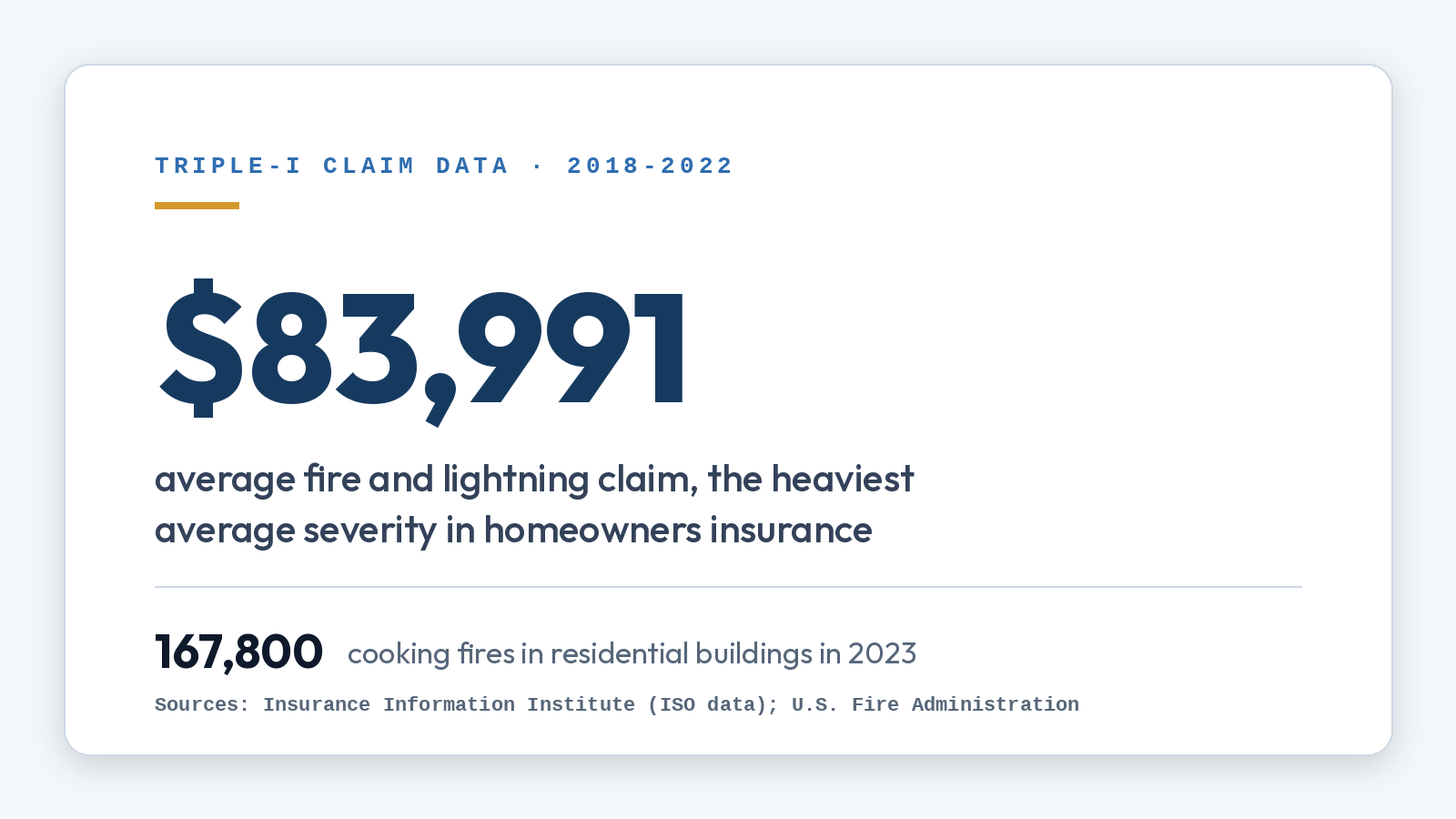
- Fire and lightning claims carry the heaviest average severity in homeowners insurance: $83,991 per claim on the 2018-2022 ISO data.
A fire damage insurance claim is the process of proving to your insurer what the fire destroyed, what it contaminated, what it cost you to live elsewhere, and what all of that costs to put right. The insurer investigates the cause, inspects the property, writes an estimate, and issues payments in stages. You supply proof at every stage, and the quality of that proof is what decides the number at the bottom.
Fires are relatively rare compared with water losses, but they are far more expensive when they happen. Fire and lightning claims averaged $83,991 apiece across the 2018-2022 ISO data compiled by Triple-I, and the causes are ordinary household ones. The U.S. Fire Administration counted 167,800 cooking fires in residential buildings in 2023 alone. Most fire claims start in a kitchen, not a catastrophe.
What are the steps in a fire damage insurance claim?
The sequence is fairly consistent across carriers, and knowing what comes next is how you stay ahead of it rather than reacting to it.
- Emergency response and the fire report. The fire department extinguishes the fire and files an incident report. Request a copy. It records the time, the responding units, and the department's cause determination, and it becomes an anchor document in your file.
- Report the loss to your insurer. Do this the same day if you can. You will get a claim number and an adjuster assignment.
- Secure the property. Every homeowners policy imposes a duty to protect the property from further damage: board-ups, tarping, fencing, and shutting off utilities. Reasonable emergency expenses are usually reimbursable, so keep every receipt and photograph the property before the work starts.
- Origin and cause investigation. On anything beyond a small loss, the carrier sends an investigator to determine how the fire started. More on this below.
- Field inspection and scoping. The insurer's adjuster walks the structure and writes an estimate, usually in estimating software, line item by line item.
- Contents inventory. You document your damaged personal property, item by item.
- Additional living expenses begin. If the home is uninhabitable, your policy starts covering the extra cost of living elsewhere.
- Proof of loss. The insurer may require a sworn statement of your claimed amounts by a set deadline. See our guide on what a proof of loss is before you sign one.
- Payment in stages. An advance, then structure payments (often naming your mortgage lender), then contents at depreciated value, then the withheld depreciation once repairs and replacements are done.
- Supplements. Hidden damage that surfaces during demolition and reconstruction gets claimed as a supplement.
Steps 5 through 10 are where the money is won or lost, and where most homeowners are negotiating against a professional for the first time in their lives.
What does homeowners insurance actually cover after a fire?
Fire is a named peril on effectively every standard homeowners policy, and it triggers four distinct buckets of coverage. Triple-I describes the standard structure as coverage for "the structure of your home; coverage for your personal belongings; liability protection; and coverage for additional living expenses."
| Coverage | What it pays for after a fire | Common trap |
|---|---|---|
| Dwelling (Coverage A) | Rebuilding or repairing the house itself, including smoke and soot remediation and code-required upgrades if you carry ordinance or law coverage | Estimate scoped to visible char only, ignoring smoke-contaminated framing and systems |
| Other structures (Coverage B) | Detached garage, fence, shed, dock, pergola | Simply forgotten; it is a separate limit, typically a percentage of the dwelling limit |
| Personal property (Coverage C) | Furniture, clothing, electronics, appliances, tools, and belongings | Paid at depreciated value first; sublimits apply to jewelry, firearms, cash, and collectibles |
| Loss of use / ALE (Coverage D) | The extra cost of living elsewhere while the home is uninhabitable | Time limits, dollar limits, and homeowners who never turn in receipts |
Two more items sit alongside these and are routinely missed. Debris removal is normally covered and is a real line item after a fire, since burned structural material is heavy and often must be handled as contaminated waste. Ordinance or law coverage, where you carry it, pays the extra cost of rebuilding to current code rather than to the code in force when the house was built. On an older home, that gap can run into six figures once electrical, plumbing, and framing standards are applied.
Pro Tip: Pull out your declarations page on day one and write down all four limits, your deductible, your ALE limit and time cap, and whether personal property is replacement cost or actual cash value. Those numbers frame every decision you make over the next six months.
How does the origin and cause investigation work, and why does it matter?
On any fire loss of size, your insurer will hire an origin and cause investigator, often a fire scene investigator working with an electrical engineer. Their work follows NFPA 921, Guide for Fire and Explosion Investigations, currently in its 2024 edition, which the National Fire Protection Association describes as the guide for forming fact-based opinions on incident origin, cause, and responsibility using the scientific method. It is the recognized methodology in this field, and the 2024 edition even adds guidance on investigator confirmation bias.
The investigation serves two purposes for the carrier, and they are not the same purpose.
Subrogation. If a defective appliance, a bad electrical component, or a contractor's work caused the fire, the insurer wants to pay your claim and then recover from whoever is responsible. This works in your favor. Evidence gets preserved, and your deductible may come back to you if subrogation succeeds.
Coverage. The other reason is to confirm the fire was not intentionally set and not excluded. Arson findings and material misrepresentation are among the few grounds on which a fire claim gets denied outright.
What this means practically: do not clean up, discard debris, or let anyone remove appliances or electrical panels before the investigation is complete and you have documented everything. Evidence spoliation cuts against the party who destroyed the evidence, and after a fire that party is often the homeowner who was simply trying to make the house safe. Photograph and video everything before any emergency work, and ask your carrier in writing when the scene is released.
If the carrier requests an examination under oath, recorded statement, or a broad document production including financial records, that is a signal the claim is being investigated rather than simply adjusted. It is not automatically an accusation, but it is the point to get professional representation involved, whether that is a public adjuster or counsel.
Does insurance cover smoke damage if nothing burned?
Yes, and this is the single most underpaid part of a typical fire claim. Smoke travels far beyond the fire itself, through hallways, HVAC returns, wall cavities, and up into the attic. It leaves residues that are acidic and corrosive, it embeds odor in porous materials, and it settles into contents in rooms that never saw flame.
Since 2025 there is finally a published consensus standard for this work: the ANSI/IICRC S700 Standard for Professional Fire and Smoke Damage Restoration, the first publicly reviewed American National Standard for fire and smoke restoration. It sets out how to assess "the presence, intensity of impact, and boundaries of fire residues and odors" affecting a building, its HVAC systems, and its contents, and it covers source removal, HVAC and air conveyance systems, odor management, contents restoration, and post-restoration evaluation.
That matters for your claim because S700 gives you a standard of care to measure the insurer's scope against. Three questions decide whether a smoke scope is adequate:
- Where are the boundaries? Was the affected area determined by assessment, or by whichever rooms looked dirty? Smoke residue is often heaviest where nobody thinks to look: closet interiors, the tops of door casings, inside cabinets, and the attic.
- Were the HVAC and duct systems assessed? A system that ran during or after the fire distributes residue through the whole house and will keep reintroducing odor after cleaning if it is not addressed.
- Is odor actually resolved, or masked? Sealing and deodorizing over unremoved residue is a temporary fix, and the smell reliably returns in the first humid month.
Cleaning versus replacement is the other running argument. Insurers prefer cleaning because it is cheaper. Sometimes cleaning is correct. But porous items, HVAC insulation, and materials with heavy residue loading frequently cannot be restored to preloss condition, and "preloss condition" is the contractual measure, not "acceptable."
How do you document contents after a fire?
The contents claim is the most tedious part of a fire claim and the part homeowners most often shortchange themselves on. Insurers typically want a room-by-room inventory listing each item, its age, its brand and model where known, its original cost, and its replacement cost today. On a whole-house fire that can run to thousands of line items.
A workable approach:
- Work from evidence, not memory. Old photos and videos of your home, social media posts, credit card and bank statements, email receipts, and warranty registrations all rebuild the record.
- Do not throw anything away until it is documented. Photograph damaged items in place, then photograph them again in a staged group with a note of what they are. If items must be discarded for safety, document them first.
- List everything, including the small things. Cleaning supplies, pantry contents, linens, towels, kids' toys, and tools disappear from most inventories and add up to thousands of dollars.
- Flag sublimited categories early. Jewelry, watches, furs, firearms, silverware, cash, and collectibles usually carry special limits well below their real value unless separately scheduled.
- Understand the depreciation math. Personal property is generally paid at actual cash value first. Triple-I notes you must "actually replace them" and provide "copies of receipts as proof of purchase" to collect the difference. That withheld portion is recoverable depreciation, and it is only recoverable if you follow through and claim it.
Pro Tip: Ask your insurer for their preferred contents inventory template and pricing method up front. Submitting your list in the format their system consumes removes weeks of back and forth and one common excuse for delay.
How do additional living expenses work after a fire?
If the fire made your home uninhabitable, your policy pays the additional cost of living somewhere else. Triple-I describes ALE as covering "hotel bills, restaurant meals and other costs over and above your usual living expenses, incurred while your home is being rebuilt or repaired." It also covers rent you would have collected from a tenant if you rent out part of the home.
Two features of ALE catch people out.
It is "additional," not total. You are reimbursed for the increase over your normal spending. If you normally spend $600 a month on groceries and now spend $1,400 eating out, the claimable amount is the $800 difference, not the $1,400. Keep the receipts anyway, all of them.
It is capped, in two ways. Triple-I notes ALE "has limits, and some policies include a time or dollar limitation." Many policies cap ALE as a percentage of the dwelling limit and cap the period at 12 or 24 months. Importantly, those limits are separate from your rebuild money: even if you exhaust ALE, "your insurance company will still pay the full cost of rebuilding your home up to the policy limit."
Claimable ALE items go well past hotels: temporary rental housing and its deposits, furniture rental, moving and storage costs, pet boarding, extra mileage if your temporary home is farther from work or school, laundry costs, and replacing basic items you need immediately. Track it in a spreadsheet from week one. Reconstructing a year of receipts at the end is how ALE money gets left behind.
What deadlines apply to a fire claim?
Deadlines run in both directions, and they are state-specific.
In Florida, for policies effective on or after December 16, 2022, Fla. Stat. § 627.70132 generally gives you 1 year from the date of loss to report a new claim and 18 months for a supplemental claim. Older policies may allow longer. Florida also holds insurers to a clock: under Fla. Stat. § 627.70131, a carrier must acknowledge claim communications within 7 days, inspect within 30 days of receiving your proof of loss, and pay or deny within 60 days of notice. Our Florida claim deadlines guide lays out the full timeline.
In South Carolina, you generally have three years to file suit on a property insurance policy under S.C. Code Ann. § 15-3-530, but your policy's own notice and proof-of-loss deadlines are usually much shorter and control how quickly you must act. Because the deadline that matters is most often the one written into your policy, report and document early. Our South Carolina property insurance claims guide covers what applies there.
On top of the statutory dates, your policy imposes its own: prompt notice, protecting the property from further damage, submitting a sworn proof of loss within a stated number of days after it is requested, and completing repairs within a stated period to collect withheld depreciation. Fire claims run long, and that last one sneaks up on people two years in.
This section is general information, not legal advice. The deadlines that govern your claim depend on your policy language and the facts of your loss.
Why do fire claims get underpaid or denied?
The outright denials are the minority. Most fire claim disputes are about amount, not coverage. The recurring reasons:
- Scope written too tight. The estimate covers what burned but not what smoke contaminated, not the HVAC system, not the attic, not the contents in adjacent rooms.
- Cleaning specified where replacement is required. Especially on porous materials, insulation, and soft contents.
- No ordinance or law allowance. The rebuild has to meet today's code, but the estimate is written to what was there before.
- Contents undervalued. Depreciation applied aggressively, replacement pricing set below what comparable items actually cost, and depreciation never recovered because nobody submitted the receipts.
- ALE cut off early. Benefits terminated while the home is still genuinely uninhabitable, or trimmed for lack of documentation.
- Hidden damage never supplemented. Damage found during demolition never makes it into a supplemental claim, and the deadline passes.
- Coverage defenses. Arson findings, material misrepresentation on the application or in the claim, vacancy provisions on unoccupied property, and late notice. These are the ones that produce a denied claim letter.
Key Takeaways
| Point | Details |
|---|---|
| Four coverages, four claims | Dwelling, other structures, personal property, and additional living expenses are documented and paid separately |
| Smoke counts | Smoke and soot damage is covered even where nothing burned; ANSI/IICRC S700 (2025) is the standard of care for assessing and restoring it |
| Investigation first | Origin and cause work follows NFPA 921 (2024 ed.); do not clean up or discard anything before the scene is documented and released |
| Payment is staged | The first check is usually an advance; contents are paid at depreciated value until you replace items and submit receipts |
| ALE is use it or lose it | Only the increase over normal expenses is reimbursed, limits and time caps apply, and undocumented spending is unrecoverable |
| Deadlines | Florida: 1 year to report, 18 months for supplements (§ 627.70132); insurer pays or denies within 60 days (§ 627.70131). South Carolina: 3-year suit limitation (§ 15-3-530), with shorter policy deadlines controlling |
What we see in the field
The pattern we see most often on fire files is a structure estimate that stops at the char line. The kitchen that burned is scoped properly. The rest of the house, where smoke rolled through every room and into the return ducts, gets a line for cleaning and a line for sealing, and that is the whole answer for two thirds of the home. Six weeks after the family moves back in, the smell comes back on the first humid week and nobody wants to reopen the file.
The second pattern is the contents inventory nobody had the stomach to finish. It is genuinely awful work, listing your children's belongings on a spreadsheet weeks after a fire, and people give up somewhere around the third bedroom. The insurer pays what was listed. We have reviewed files where the gap between what was claimed and what was actually in the house ran well into five figures, purely because the list stopped.
Third is living expenses. Homeowners front the cost of a hotel and restaurant meals for weeks, do not keep the receipts because they assume the insurer has the numbers, and then find out reimbursement runs on documentation. On a long rebuild, ALE is often the second largest piece of the claim after the structure itself, and it is the piece most likely to be left on the table.
The through line is that fire claims are long. Structure work runs months, sometimes years, and files that start well drift when everybody is exhausted. The documentation you build in the first two weeks is what carries the claim when everyone's attention has moved on.
- The Vanguard field team
How Vanguard Claims Solutions helps
If your fire claim estimate does not look like it covers what actually happened to your home, we can review it. Vanguard Claims Solutions is a public adjusting firm licensed in Florida and South Carolina, led by Andrew Pichardo (FL Public Adjuster License #W493213, SC License #18873906). We scope the loss independently, build the contents and living expense documentation, and negotiate the claim on your behalf. We offer a free claim review and work with no upfront fees; the fee for your claim is set out in the written contingency agreement before you sign, and if there is no recovery, there is no fee. Call (305) 336-3302 or reach us through our contact page.
FAQ
How long does a fire insurance claim take?
Small kitchen fires can settle in weeks. A significant fire loss commonly runs six months to well over a year, because the structure has to be investigated, scoped, rebuilt, and inspected, and hidden damage surfaces during demolition. Florida law gives insurers 60 days from notice to pay or deny under Fla. Stat. § 627.70131, but that governs the coverage decision, not how long the rebuild takes.
Does homeowners insurance cover smoke damage without fire damage?
Generally yes, when the smoke comes from a sudden covered event such as a fire in your home or a nearby structure. The residue, odor, and corrosion smoke leaves behind are covered damage, and the ANSI/IICRC S700 standard sets out how the affected boundaries should be assessed. Coverage still depends on your specific policy language.
Will my insurance company pay to replace everything, or just clean it?
It depends on whether the item can be restored to preloss condition. Insurers prefer cleaning because it costs less, and for many hard, nonporous surfaces cleaning is appropriate. Porous materials, insulation, and heavily contaminated soft contents often cannot be restored, and that is where disputes concentrate.
Can my insurance company deny a fire claim?
Yes, but outright fire denials are relatively uncommon and usually rest on specific grounds: arson, material misrepresentation on the application or during the claim, a vacancy provision on an unoccupied property, or late notice. Most fire disputes are about the amount paid rather than whether coverage exists. If you have received a denial, our denied claims page explains the options.
Should I hire a public adjuster for a fire claim?
Fire claims are the most document-intensive claims in residential property insurance, involving a structure scope, a line-item contents inventory, smoke assessment, and a running living expense ledger, often while you are displaced. That is exactly the situation where independent representation tends to pay for itself. Our guide on whether public adjusters are worth it walks through how to decide.
Recommended
Dealing with this claim right now?
A licensed adjuster will review your loss and policy for free, with no obligation.