What Is a Third-Party Adjuster? Independent vs Staff vs Public
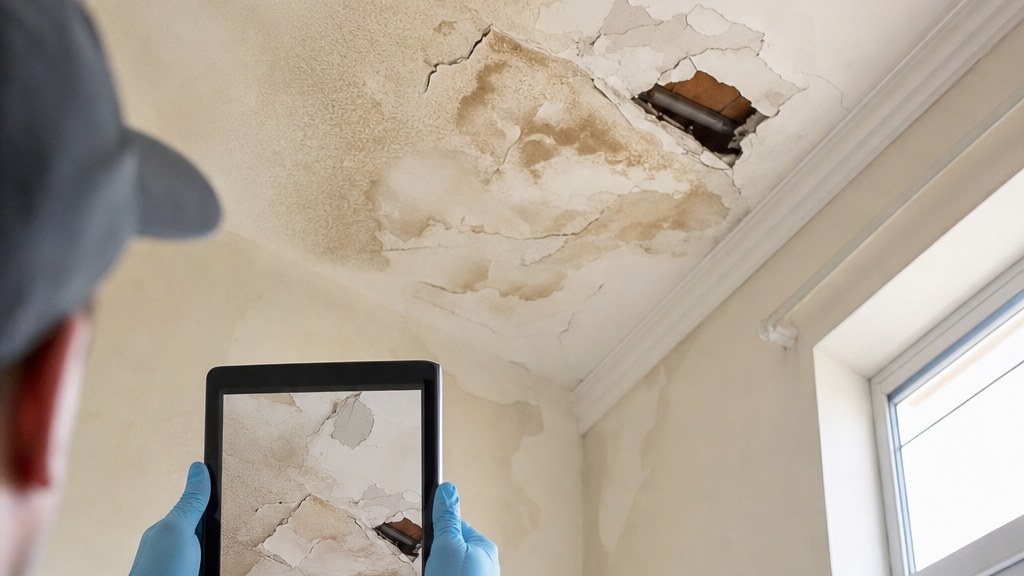
Someone knocks on your door two weeks after the storm, hands you a business card that says "independent adjuster," and starts photographing your roof. Here is who that person actually works for, and why the word "independent" is the most misread word on the card.
TL;DR:
- A third-party adjuster is an adjuster the insurance company hires under contract rather than employing directly. The industry usually calls this an independent adjuster, and Florida law defines the role as acting "on behalf of an insurer."
- "Independent" describes the employment relationship, not whose side the adjuster is on. The carrier hires the adjuster, the carrier pays the adjuster, and the carrier is the client.
- A staff or company employee adjuster is on the insurer's own payroll (Fla. Stat. § 626.856). A desk adjuster works the file remotely. A CAT adjuster is deployed for a specific catastrophe. All three are paid by the carrier.
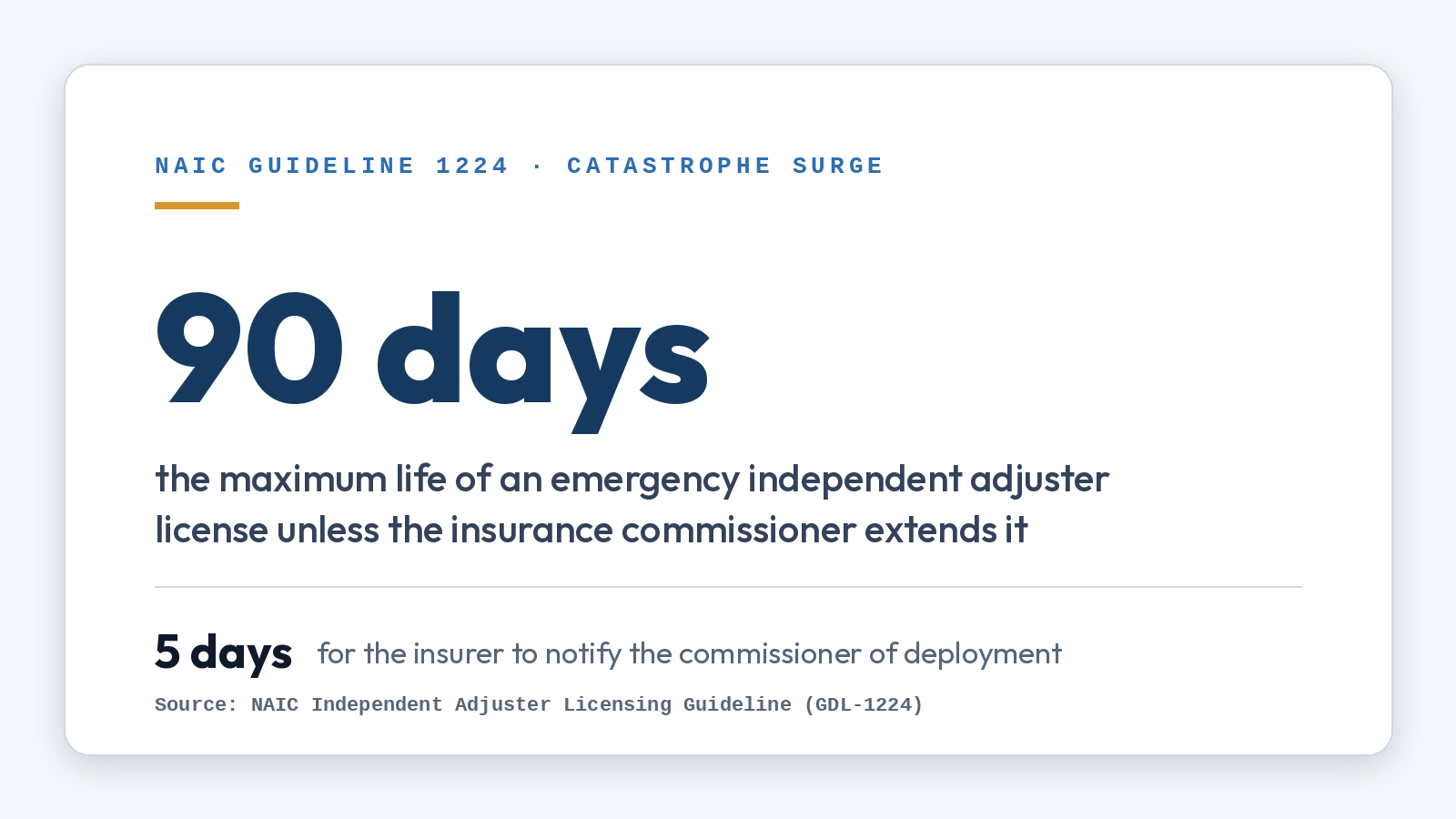
- After a declared catastrophe, states let insurers put temporary emergency adjusters in the field fast. Under the NAIC Independent Adjuster Licensing Guideline, an emergency independent adjuster license runs no more than 90 days unless extended.
- The public adjuster is the only one in the list hired by, and answering to, the policyholder. Our guide to public adjuster vs. insurance adjuster covers that comparison in detail.
A third-party adjuster is a licensed claims adjuster the insurance company brings in under contract instead of using its own employees. In statute and in everyday industry use, this is the independent adjuster: a contractor, or an employee of an independent adjusting firm, who inspects your damage, writes an estimate, and reports back to the carrier that hired them.
The confusion is understandable. The property claims business has generated at least six job titles that all end in "adjuster," and most homeowners meet two or three of them on a single claim without anyone explaining the difference. This article is the taxonomy: who each one is, who signs their check, and what to ask the person standing in your driveway.
What is a third-party adjuster, exactly?
A third-party adjuster is an adjuster who is not an employee of the insurance company but handles the insurer's claims under contract. "Third party" refers to the contracting arrangement, not to a third party in the legal sense of someone outside the policy.
Florida's statutory definition is the clearest short version available. Under Fla. Stat. § 626.855, an independent adjuster is a person licensed as an all-lines adjuster "who is self-appointed or appointed and employed by an independent adjusting firm or other independent adjuster, and who undertakes on behalf of an insurer to ascertain and determine the amount of any claim, loss, or damage payable under an insurance contract or undertakes to effect settlement of such claim, loss, or damage."
Read the operative phrase again: on behalf of an insurer. That is the whole answer to "who does the insurance adjuster work for." The model definition used across the states agrees: the NAIC Independent Adjuster Licensing Guideline defines an independent adjuster as an individual or business entity that "contracts for compensation with insurers or self-insurers," and whose tax treatment by the insurer is that of an independent contractor rather than an employee.
So the difference between a staff adjuster and an independent adjuster is a payroll question. Both work the carrier's file, in the carrier's software, against the carrier's guidelines.
Who does each type of adjuster work for?
Here is the full taxonomy in one place. This is the table to keep.
| Title you may hear | Who hires them | Who pays them | Whose interest they serve | Typical role on your claim |
|---|---|---|---|---|
| Staff / company employee adjuster | The insurer, as an employee | The insurer | The insurer's | Handles claims year-round for one carrier |
| Independent (third-party) adjuster | The insurer, under contract, usually through an IA firm | The insurer | The insurer's | Surge and overflow work, field inspections |
| Desk adjuster | The insurer (may be staff or independent) | The insurer | The insurer's | Works the file remotely, reviews estimates, makes the payment decision |
| Field adjuster | The insurer (may be staff or independent) | The insurer | The insurer's | Physically inspects the property and writes the scope |
| Catastrophe (CAT) adjuster | The insurer, usually as a deployed independent adjuster | The insurer | The insurer's | Deployed to a storm zone for a defined event, high caseload |
| Third-party administrator (TPA) | The insurer, MGA, or self-insured program | The insurer or program | The program's | Administers claims handling as an outsourced operation |
| Public adjuster | You, the policyholder | You, on contingency | Yours | Documents, values, and negotiates the claim for you |
Six of the seven rows point in the same direction. Only the last one points at you.
None of that makes the carrier's adjusters dishonest. It makes them employed. An adjuster working the insurer's file applies the insurer's estimating platform, price list, depreciation schedule, and claim guidelines, because that is the job. The problem is not villainy. It is that the only person in the process whose job is to argue for a bigger number is the one you have not hired yet.

Why do you meet an independent adjuster after a hurricane?
Because no insurer staffs for its worst week. Carriers size their in-house adjusting departments for ordinary claim volume: kitchen fires, burst supply lines, a tree through a soffit. A landfalling hurricane can generate more claims in seventy-two hours than that staff would normally see in a year, and the only way to inspect all of those properties is to contract for people. Surge capacity is exactly what independent adjusting firms sell. They keep rosters of licensed adjusters who deploy to declared catastrophes, work the event, and move on.
The regulatory system is built to make that fast. Under the NAIC Independent Adjuster Licensing Guideline, when a catastrophe is declared, an insurer notifies the insurance commissioner and can put a qualified but not-yet-licensed-in-state adjuster to work, with notification required within five days of deployment. That emergency license or registration "shall remain in force for a period not to exceed 90 days, unless extended by the insurance commissioner." Florida has its own version: Fla. Stat. § 626.874 authorizes catastrophe or emergency adjuster licenses for individuals designated and certified by an authorized insurer or a licensed independent adjusting firm, for the period of the emergency as the department determines.
Two practical consequences follow. First, after a major storm the adjuster who inspects your home is often not the adjuster who decides your claim, and may not be the one who returns for the reinspection. Deployments end and files get reassigned, so anything living only in someone's memory of your property is lost. Photographs, measurements, and written scopes matter far more on a catastrophe claim than on a routine one.
Second, deployment caseloads are enormous. An adjuster moving through a neighborhood on a storm rotation is not careless on purpose; they are working the volume they were sent to work. Rushed scopes miss the same list every time: interior water tracking, code-required upgrades, matching, detached structures, and contents.
Pro Tip: Write down the name, license number, and adjusting firm of every adjuster who touches your claim, along with the date they inspected. On a catastrophe claim you will frequently need to explain your own file history to the third or fourth person assigned to it.
What does "independent" actually mean, and what does it not mean?
It means the adjuster is not on the insurer's payroll. That is all it means.
What it does not mean:
- It does not mean neutral. The independent adjuster's client is the insurance company that retained them. They are not standing between you and the carrier; they are on one side of it.
- It does not mean they set the number. On many files the field adjuster writes a scope and someone else, often a desk adjuster or claim examiner, approves, cuts, or overrides it. If your field adjuster seemed sympathetic and the payment did not reflect that, this is usually why.
- It does not mean they work for you if they are friendly. Most are decent people doing a hard job in bad conditions. Rapport is not representation.
- It does not mean they are unqualified. Independent adjusters carry the same adjuster license as staff adjusters in most states, including Florida, where all three roles run off one all-lines adjuster license with different appointment types.
The question that cuts through all of it is the one people are shy about asking: who pays you? Everyone above answers "the insurance company," except a public adjuster.
Desk adjuster, field adjuster, CAT adjuster: what is the difference?
These three are not a separate species. They describe what the adjuster is doing, and any of them can be staff or independent.
- Field adjuster. Goes to the property, inspects, photographs, measures, and writes the scope of damage. This is the person you actually meet.
- Desk adjuster. Handles the file remotely: reviews the field scope, requests documents, communicates by phone and email, and often holds settlement authority. On low-severity claims, some carriers now run the entire file from the desk using photos or video you submit yourself.
- Catastrophe (CAT) adjuster. Deployed for a specific declared event, typically an independent adjuster working a storm rotation. High volume, temporary assignment, frequently licensed into your state on an emergency or nonresident basis for that event.
You will often deal with all three on one hurricane claim: a CAT field adjuster inspects, a desk adjuster runs the file, and a later reinspection gets assigned to a fourth person entirely.
What is a TPA, and is a TPA an adjuster?
A third-party administrator is an outsourcing arrangement, not a person in your driveway. A TPA is a company hired to administer some or all of an insurance program's operations, which can include intake, claim handling, and payment, on behalf of an insurer, a managing general agent, or a self-insured entity.
The distinction that matters to a policyholder is scope. An independent adjuster is a licensed individual working one piece of your claim. A TPA is an organization running the claims operation itself, sometimes under the carrier's brand, so you may never notice the difference from the outside. Some states license these entities directly: Florida regulates "administrators" under Fla. Stat. § 626.88, a definition built around persons who collect premiums or adjust and settle claims in connection with commercial self-insurance funds or insured and self-insured life and health programs.
The practical takeaway is unchanged: whoever the entity is, it was hired and is paid by the risk-bearing side.
Are third-party adjusters licensed, and what rules bind them?
Yes. Adjusters are state-licensed, and the licensing regime covers the carrier's adjusters and yours alike.
In Florida, all three roles sit on the same all-lines adjuster license with different appointments: company employee adjuster (§ 626.856), independent adjuster (§ 626.855), and public adjuster (§ 626.854). Adjusting firms must designate a primary adjuster with the Department of Financial Services and may not conduct business without one (§ 626.8695). The Department of Financial Services publishes the current adjuster license types and application requirements on its agent and adjuster qualifications page, where company and independent appointments run on the all-lines adjuster license (type 6-20 for residents) and the resident public adjuster license is issued as type 3-20.
Florida's ethics rule is worth reading if you want to know what the person at your door owes you. Fla. Admin. Code R. 69B-220.201 applies by its own terms to "all types and classes of insurance adjusters, (company employee, independent, and public) ... regardless of whether permanent, temporary, apprentice, or emergency licensees." It provides that an adjuster "shall not knowingly fail to advise a claimant of the claimant's claim options in accordance with the terms and conditions of the insurance contract," and prohibits steering a claimant to anyone with whom the adjuster has an undisclosed financial interest. Note the limit: it imposes conduct standards on the carrier's adjuster. It does not make that adjuster your representative.
In South Carolina, adjusters are likewise licensed. Under S.C. Code Ann. § 38-47-10, an individual "commonly called an adjuster, adjusting losses for an insurer licensed to do business in this State, must be licensed by the director or his designee," and the director may enter reciprocal licensing agreements with other states for nonresident adjusters under § 38-47-20. South Carolina public adjusters are separately governed by S.C. Code Ann. Title 38, Chapter 92, which requires a written contract before any work begins and gives the policyholder five business days to cancel it.
Licensing tells you the person is qualified and accountable to a regulator. It does not tell you whose interest they serve. Conflating those two questions is the most common misunderstanding we encounter.
This section is general information, not legal advice. How these rules apply to your claim depends on your policy, your state, and the facts of your loss.
What should you ask the adjuster who shows up at your door?
Ask these five and write down the answers. Every one is a question a legitimate adjuster answers without hesitation.
- "Are you a staff adjuster or an independent adjuster?" You are asking whether they are employed by the carrier or contracted through an adjusting firm. Either answer is fine. The non-answer is the signal.
- "What is your license number and your firm's name?" Both are public. Verify in Florida through the Department of Financial Services and in South Carolina through the South Carolina Department of Insurance.
- "Will you write the estimate, and who approves it?" This surfaces the desk adjuster behind the field adjuster, and tells you where the decision is actually made.
- "Will I get a complete copy of the estimate, with line items and depreciation?" Ask for the full estimate, not the summary or the check stub. You cannot dispute a number you have never seen. Our post on what an insurance appraisal is covers what happens when two estimates cannot be reconciled.
- "What are the next steps and the dates that apply to me?" Deadlines are yours to meet, not theirs to remember. See our Florida claim deadlines guide or our South Carolina claims guide.
Pro Tip: Be present for every inspection, take your own photographs of everything the adjuster photographs, and take a few of what they skip. Your parallel photo set is the cheapest claim insurance there is, and it costs nothing but an hour.
So where does a public adjuster fit in all this?
A public adjuster is the mirror image of everyone above: licensed by the same state, doing much of the same technical work, and retained by the policyholder rather than the carrier. Under Fla. Stat. § 626.854, a public adjuster is a person who, for compensation, "directly or indirectly prepares, completes, or files an insurance claim for an insured or third-party claimant," or who acts on behalf of an insured in negotiating a claim settlement. That same section gives a Florida policyholder the right to cancel a public adjuster contract without penalty within 10 days of signing, or, when the contract follows a Governor-declared state of emergency, within 30 days after the date of loss or 10 days after signing, whichever is longer.
We have written the full side-by-side comparison already, including who pays whom and what a public adjuster does that a carrier's adjuster has no reason to do. Read public adjuster vs. insurance adjuster next, or what is a public adjuster if you are starting from scratch. For whether it makes sense on your claim, see are public adjusters worth it and how public adjuster cost works.
Key Takeaways
| Point | Details |
|---|---|
| Third-party adjuster = independent adjuster | A licensed adjuster contracted by the insurer rather than employed by it; Florida defines the role as acting "on behalf of an insurer" (§ 626.855) |
| "Independent" is an employment term | It describes the contracting relationship, not neutrality. The carrier hires and pays the adjuster |
| Staff, desk, field, CAT | Staff means the insurer's payroll (§ 626.856); desk, field, and CAT describe the function, and any of them can be staff or independent |
| TPA is an organization | A third-party administrator runs claims operations for a carrier, MGA, or self-insured program; Florida regulates "administrators" under § 626.88 |
| Storm surge is why you meet one | Emergency and catastrophe licensing exists to deploy adjusters fast; the NAIC guideline caps an emergency independent adjuster license at 90 days unless extended |
| All are licensed; only one is yours | Florida licenses all three appointment types on one all-lines license and holds them all to R. 69B-220.201; South Carolina licenses adjusters under § 38-47-10 and public adjusters under Title 38, Ch. 92 |
| The question that resolves it | Ask who pays them. Every answer is "the insurance company" except the public adjuster you hire |
What we see in the field
The pattern we see most often is not a bad adjuster. It is a rotating one. On catastrophe claims the file passes through several hands, and each handoff loses context: what was found in the attic, what the homeowner was told about a reinspection, which photographs were taken but never attached. Homeowners assume the file remembers. It remembers only what is documented in it, which is why we rebuild the documentation from scratch rather than argue about what somebody said in October.
The second pattern is the word itself. Homeowners hear "independent adjuster" and relax, because "independent" sounds like "neutral." Then the estimate arrives short and they feel misled by someone who never actually misled them. Nobody lied; the title just does not mean what it sounds like. When we explain that "independent" refers to who signs the paycheck, the reaction is usually a long pause, because it reframes every conversation they have already had.
The third pattern is the field-versus-desk split, which surprises people constantly. A homeowner gets a thorough inspection, the adjuster agrees on site that the damage is significant, and the payment comes back at a fraction of that. Nothing sinister happened. The field adjuster documents; someone else applies the guidelines, the price list, and the depreciation. A friendly inspection is not a settlement, and what ends up in writing is the only part that ever matters.
- The Vanguard field team
How Vanguard Claims Solutions helps
If an adjuster has inspected your property and you are not sure who they worked for or whether the estimate reflects the real loss, we can review it with you. Vanguard Claims Solutions is a public adjusting firm licensed in Florida and South Carolina, led by Andrew Pichardo (FL Public Adjuster License #W493213, SC License #18873906). We re-inspect the property, build an independent, documented, line-item scope, and handle the negotiation, supplement, appraisal, or reopening from there. We offer a free claim review and work with no upfront fees; the fee for your claim is set out in the written contingency agreement before you sign, and if there is no recovery, there is no fee. Call (305) 336-3302 or reach us through our contact page.
FAQ
Is a third-party adjuster the same as an independent adjuster?
In everyday usage, yes. Both describe a licensed adjuster the insurance company retains under contract rather than employing directly, usually through an independent adjusting firm. Florida's statutory term is "independent adjuster" (Fla. Stat. § 626.855). Do not confuse it with a third-party administrator (TPA), which is a company running claims operations, not an individual adjuster.
Does the independent adjuster work for me or for the insurance company?
For the insurance company. The carrier hires them, the carrier pays them, and the statutory definition says they act "on behalf of an insurer." The word "independent" refers to their contractor status, not to independence from the insurer's interests. Only a public adjuster you hire represents you.
What is the difference between a staff adjuster and an independent adjuster?
Employment. A staff or company employee adjuster is on the insurer's payroll (Fla. Stat. § 626.856); an independent adjuster is a contractor or an employee of an adjusting firm the insurer retains. Both work the carrier's file under the carrier's guidelines, and both are paid by the carrier. Insurers lean on independent adjusters heavily after catastrophes, when claim volume outruns in-house staffing.
Can I refuse to let an independent adjuster inspect my property?
Generally not without risk. Standard property policies impose duties after loss that include allowing the insurer to inspect the damaged property, and refusing can give the carrier a coverage defense. The better move is to cooperate fully while documenting everything yourself and, if you want representation, hiring your own licensed public adjuster. See when is it too late to hire a public adjuster for the timing question.
How do I check whether an adjuster is licensed?
Ask for the license number and the firm name, then verify with the state regulator. Florida licenses are searchable through the Department of Financial Services, and South Carolina licenses through the South Carolina Department of Insurance. Adjusters in both states must be licensed, and a legitimate adjuster will give you the number without being pressed.
Recommended
Dealing with this claim right now?
A licensed adjuster will review your loss and policy for free, with no obligation.