Will Homeowners Insurance Pay for a New Roof? What Actually Decides It
Ask ten neighbors whether insurance paid for their roof and you will get ten different answers, all of them true. One got a full replacement, one got a patch, one got a check for a third of what the roofer wanted, one got denied. Same storm, same street.
TL;DR:
- Homeowners insurance pays for a roof when a covered, sudden peril damaged it: wind, hail, a fallen tree, fire. It does not pay for a roof that is simply old, worn, or leaking from neglect.
- Whether you get a full replacement or a repair depends on how much of the roof is damaged, whether a repair can actually restore it, and, in Florida, on the building code's 25% roof rule and its 2022 exception.
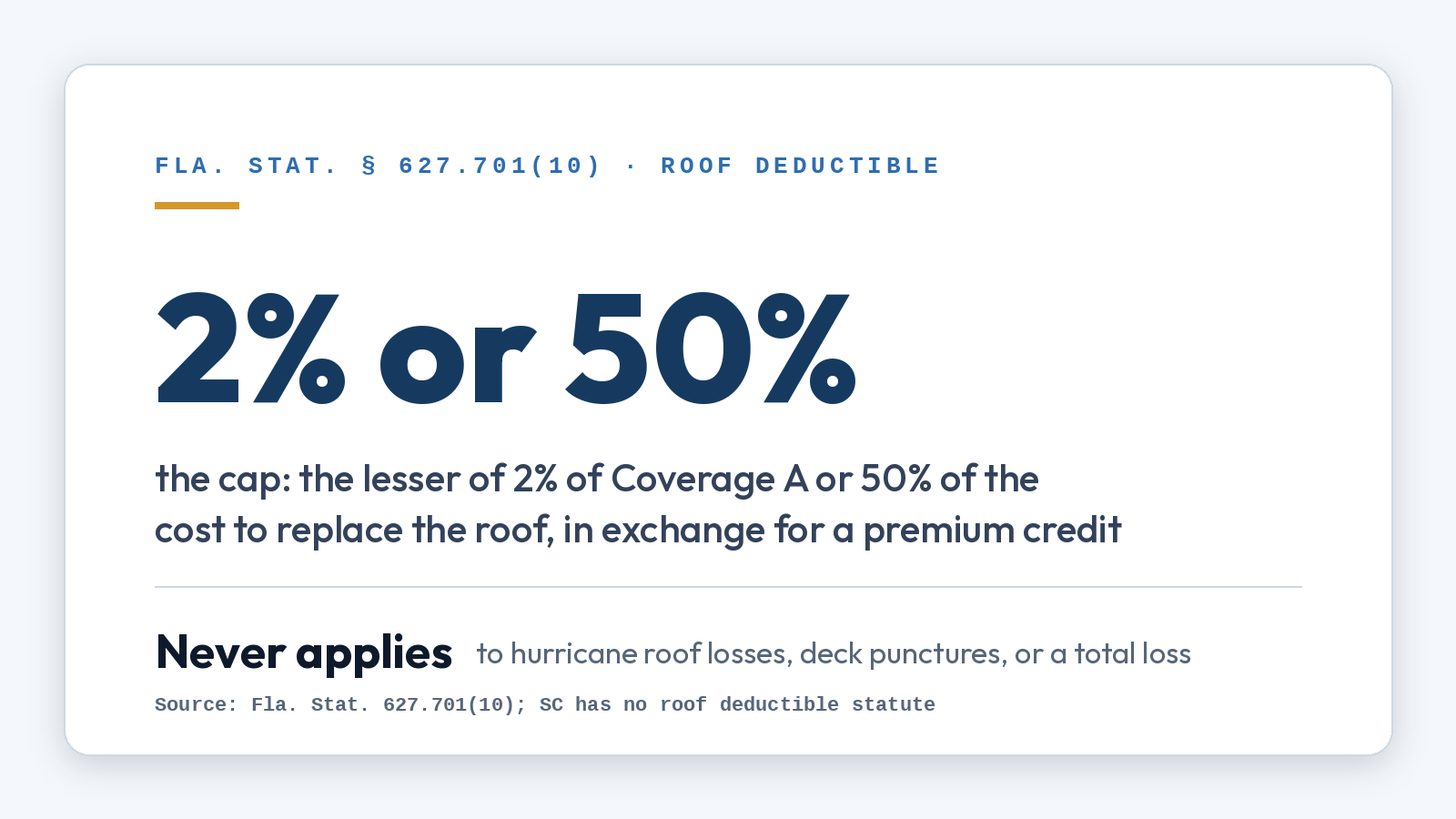
- How much you get depends on whether your roof is covered at replacement cost or actual cash value. Florida allows a separate roof deductible of up to the lesser of 2% of the dwelling limit or 50% of the roof's replacement cost under Fla. Stat. § 627.701(10), with important exceptions.
- Florida insurers cannot refuse to write or renew a policy solely because a roof is under 15 years old, and must accept an inspection showing 5 or more years of remaining life on an older roof, under § 627.7011(5).
- South Carolina has no roof rule and no roof-specific statute. What you get on an SC roof claim is set by your policy's own terms.
General information, not legal advice. Your policy controls.
The roof is the single most contested item on a property claim in both states we work in. It is the most expensive component most homeowners will ever claim, it is the one carriers have written the most endorsements around, and it is the one where the gap between a roofer's quote and an insurer's first number is widest. So let us take the question apart the way an adjuster does.
The first question is not "how bad is the roof." It is "what caused it."
Every homeowners policy insures against perils, not conditions. A roof with missing shingles after a windstorm is a peril loss. A roof with the same missing shingles because the seal strips failed with age is a maintenance condition. The photographs can look identical. The claim outcomes are opposite.
| Cause of the damage | Typically covered? | Why |
|---|---|---|
| Wind lifting, creasing, or tearing off shingles | Yes | Sudden covered peril |
| Hail bruising or fracturing the shingle mat | Yes, subject to any cosmetic exclusion | Sudden covered peril |
| Tree or limb impact, debris puncture | Yes | Sudden covered peril |
| Fire or lightning | Yes | Sudden covered peril |
| Hurricane wind (FL, SC) | Yes, with the hurricane or named-storm deductible | Sudden covered peril |
| Granule loss, curling, cracking from age | No | Wear and tear, deterioration |
| Long-term leak from a failed flashing or boot | Usually not | Repeated seepage, lack of maintenance |
| Installation defects | No | Faulty workmanship exclusion |
| Flood or storm surge | No | Excluded on homeowners; separate flood policy |
The whole argument in a roof claim happens in the space between the top of that table and the bottom. Carriers look at an older roof and see wear. Homeowners look at a roof that was fine last month and see a storm. The evidence that settles it is specific: creased shingles with a directional pattern, fractured mats under hail bruises, lifted tabs with broken seals, a date-stamped weather report, and a prior condition you can prove.
Pro tip: photograph your roof from the ground and from a drone or ladder once a year and after every significant storm, even when nothing looks wrong. Nothing you do after a loss is as valuable as a dated picture of the roof before it, because it removes the carrier's easiest argument, which is that the damage was already there.
Repair or replace: the question that decides most of the money
A carrier will always evaluate whether the damage can be repaired before it agrees to replace. Its adjuster counts damaged shingles per slope, checks whether matching shingles are available, and estimates what a repair would cost against a full tear-off. If the numbers and the roof condition support a repair, the first offer will be a repair.
Three things push a claim from repair to replacement:
- The damage is too widespread to repair. Once damaged shingles are scattered across a slope or the whole roof, a repair stops being a repair. Industry practice varies, but adjusters commonly treat a slope with damage beyond a certain density as a replacement slope.
- A repair cannot restore the roof. Brittle, aged shingles fracture when lifted to slide a replacement in. Discontinued products cannot be matched. A repair that creates new damage is not a repair the policy contemplates.
- The building code requires more. This is the Florida-specific part, and it matters enough to get its own section.
Matching in Florida
Florida has a statute on matching. Fla. Stat. § 626.9744 provides that, unless the policy says otherwise, when a loss requires replacement of items and the replaced items do not match in quality, color, or size, the insurer must make reasonable repairs or replacement of items in adjoining areas. Note the section's own exception for policies that "otherwise provide," which is why so many Florida forms now carry endorsements limiting matching. Read yours.
South Carolina has no matching statute. What you get depends entirely on the policy language, and most standard forms leave matching to the adjuster's reasonable judgment.
Florida's 25% roof rule, and the 2022 exception that changed it
For years the Florida Building Code required that when more than 25% of a roof section was repaired, replaced, or recovered within any 12-month period, the entire section be brought up to current code. In practice that meant a storm that took out a third of one slope frequently produced a full roof replacement, because bringing the rest to code was cheaper than trying to marry a code-compliant patch to a non-compliant roof.
In 2022 the Legislature added an exception. Fla. Stat. § 553.844(5) now provides that when a roof was built, repaired, or replaced in compliance with the 2007 Florida Building Code or a later edition, and 25% or more of it is repaired or replaced, only the repaired, replaced, or recovered portion is required to be constructed in accordance with the current code.
What that means at the kitchen table:
| Your roof | Damage covers more than 25% of a section | Likely code outcome |
|---|---|---|
| Built or replaced under a pre-2007 code | Yes | Whole section to current code (frequently a full replacement) |
| Built or replaced to the 2007 FBC or later | Yes | Only the repaired portion must meet current code |
| Any roof | No | Repair the damaged area |
Two cautions. First, "built to the 2007 code" is a fact you have to be able to prove with a permit record, not a memory. Second, the exception addresses what the code requires; it does not change what a policy owes. Whether a partial repair is actually feasible on your roof, and whether the carrier's proposed repair is a real one, remain claim questions.
Nothing in this section applies in South Carolina. SC has no 25% rule, and roof scope there is a matter of the damage and the policy.
Replacement cost, actual cash value, and the roof schedule
Here is where "insurance paid for my roof" becomes "insurance paid for a third of my roof."
Replacement cost value (RCV) pays what it costs to replace the roof with like kind and quality, without deducting for age. Actual cash value (ACV) pays replacement cost minus depreciation, and a fifteen-year-old shingle roof is heavily depreciated. If your roof is covered at ACV, the check for a full replacement can be a fraction of the roofer's number, and that is the policy working as written, not a lowball.
Since 2022, Florida insurers have had several tools to move roofs toward ACV or toward a larger deductible:
- Roof deductible. Under § 627.701(10), a policy may carry a separate roof deductible of up to the lesser of 2% of the Coverage A limit or 50% of the cost to replace the roof. In exchange, the premium must include an actuarially sound credit. Crucially, the roof deductible does not apply to a total loss of the primary structure, a roof loss from a hurricane, a roof loss from a tree fall or other hazard that punctures the roof deck, or a roof loss requiring repair of less than 50% of the roof. And when a roof deductible is applied, no other deductible may be applied to the same loss.
- ACV until proof of payment. Under § 627.7011(3)(a), where a roof deductible applies, the insurer may limit its payment to the ACV of the roof loss until it receives reasonable proof of payment for the work.
- Roof surface payment schedules. Some Florida policies, with a signed acknowledgment from the policyholder, pay roofs on a schedule that reduces the recovery as the roof ages. If you accepted one of these at renewal in exchange for a lower premium, it governs the roof claim.
On a standard replacement cost dwelling policy without those endorsements, § 627.7011(3)(a) sets the basic rule: the insurer must initially pay at least the ACV, less the deductible, and pay the remaining amounts as work is performed and expenses are incurred. On a total loss it must pay replacement cost without reservation or holdback. That is the recoverable depreciation mechanism, and we have written a full guide to it.
South Carolina policies use the same RCV and ACV concepts, but there is no SC statute regulating roof deductibles or roof schedules. Your declarations page and endorsements decide.
Pro tip: read the roof line of your declarations page today, not after a storm. The words to look for are "roof surfacing payment schedule," "actual cash value roof," and "roof deductible." Each one changes what a roof claim is worth before the first shingle lifts, and each one is usually removable at renewal for a premium difference you should at least know about.
Roof age: what Florida insurers can and cannot do
Roof age is the reason most Florida homeowners are nervous about roof claims in the first place, because a nonrenewal over roof condition has become the most common notice in the state.
Fla. Stat. § 627.7011(5) sets the rules:
- An insurer may not refuse to issue or renew a homeowner's policy on a residential structure with a roof less than 15 years old solely because of the roof's age.
- For a roof 15 years or older, the insurer must allow the homeowner to have a roof inspection performed by an authorized inspector, and may not refuse to issue or renew solely because of roof age if the inspection indicates the roof has 5 years or more of useful life remaining.
Those protections are about underwriting, not claims. They stop age alone from ending your policy. They do not turn an old, worn roof into a covered loss. But they matter for the decision this article is really about: whether to file. Many homeowners sit on real storm damage because they assume the claim will cost them the policy. The rules on cancellation and nonrenewal after a claim are more protective than most people expect, and a documented, covered storm loss is a very different thing to an underwriter than a roof that is simply failing.
What a roof claim actually pays for
Even when the roof itself is agreed, first estimates routinely miss line items that a complete scope includes:
- Tear-off and disposal of the existing roof covering
- Underlayment, drip edge, starter, ridge cap, and flashing to current code, not just shingles
- Decking replacement where the deck is rotten, delaminated, or fails a nailing inspection
- Code upgrades required by the permit, paid through the policy's law and ordinance coverage. Under § 627.7011(1), Florida insurers must offer this at 25% or 50% of the dwelling limit; check which you carry. In SC, check whether your policy includes it at all.
- Permits and inspections
- Interior damage from water that entered through the storm-created opening, and the cost to find it
- Contractor overhead and profit where the job requires a general contractor coordinating trades
A roofer's quote for shingles and labor is not a scope. A scope is every line the policy owes on that loss, priced at current local rates.
What we see in the field
The pattern we see most is the repair offer on a roof that cannot be repaired. The carrier's estimate lists forty shingles on two slopes. The shingles are twelve years old, brittle, and discontinued. Any roofer who touches them will break the neighbors. When we document that with photographs of test lifts and the manufacturer's discontinuation, the conversation changes from a patch to a slope, and often from a slope to a roof.
The second pattern is the ACV surprise. A homeowner with a roof surfacing schedule they signed at renewal, for a premium credit they do not remember, learns after the storm that a covered full replacement pays out at a fraction of the cost. Nothing in the claim is wrong. The policy is doing what the endorsement says. The only fix is at renewal, and we tell people that plainly.
The third is the code miss. A Florida estimate that scopes shingles only, on a permitted replacement that requires secondary water barrier, drip edge, and a re-nailed deck to current code, leaves the law and ordinance coverage untouched and the homeowner writing a check for the difference. Those items are covered when they are scoped and claimed.
How Vanguard Claims Solutions helps
We are licensed public adjusters. We represent you, never the insurer, and on roof claims that means three things.
Before you file, we inspect at no cost and tell you what the roof actually shows: whether the damage is a covered peril, whether a repair is realistic, and roughly what a complete scope is worth against the deductible that applies. If the honest answer is that a claim will not clear the deductible, we say so.
During the claim, we document every slope with test squares, dated photographs, and weather data, write the full scope including code and interior items, and handle the carrier's adjuster and any reinspection.
When the offer is short, we work the difference: the repair that is not a repair, the depreciation that is recoverable, the code items that were never scoped, and the supplements when the tear-off reveals what the estimate could not see.
There are no upfront fees and no recovery, no fee. The fee for your claim is set out in the written contingency agreement before you sign anything.
Andrew Pichardo · FL Public Adjuster Lic. #W493213 · SC Public Adjuster License #18873906
Call (305) 336-3302 or request a free claim review.
Key takeaways
| Question | Short answer |
|---|---|
| Will insurance pay for a new roof? | Yes, when a covered sudden peril damaged it and a repair cannot properly restore it |
| Will it pay for an old, worn roof? | No. Wear, deterioration, and neglect are excluded |
| Repair or replace? | Depends on damage density, whether a repair can restore the roof, and in FL the building code |
| What is Florida's 25% roof rule now? | More than 25% of a section repaired means the section goes to code, unless the roof was built to the 2007 FBC or later, in which case only the repaired portion must |
| How big can a Florida roof deductible be? | The lesser of 2% of Coverage A or 50% of the roof replacement cost, and it never applies to hurricane losses or deck punctures |
| Can my Florida insurer drop me over roof age? | Not solely for age under 15 years, and not at 15+ if an inspection shows 5 or more years of life |
| Does any of this apply in South Carolina? | No. SC has no roof rule, no matching statute, and no roof deductible statute. Your policy terms control |
FAQ
Does homeowners insurance cover a new roof if the old one is just worn out?
No. Homeowners insurance covers sudden, accidental damage from named or open perils such as wind, hail, fire, and falling objects. Deterioration from age, wear and tear, and lack of maintenance are excluded on every standard form. A worn roof that then fails in a storm is the hard case: the carrier will argue the storm only finished what age started, and the evidence of the roof's pre-storm condition decides it.
How much of my roof has to be damaged for insurance to replace the whole thing?
There is no universal percentage in the policy. Adjusters evaluate whether a repair can restore the roof with matching materials without creating new damage. In Florida, the building code adds a threshold: repairing or replacing more than 25% of a roof section within 12 months triggers code compliance for the section, unless the roof was built or replaced to the 2007 Florida Building Code or later, in which case only the repaired portion must comply under § 553.844(5). South Carolina has no equivalent rule.
What is a roof deductible in Florida?
A separate deductible some Florida policies apply to roof losses, permitted by § 627.701(10) up to the lesser of 2% of the dwelling limit or 50% of the roof replacement cost, in exchange for a premium credit. It cannot apply to a total loss, a hurricane roof loss, a tree fall or other hazard that punctures the roof deck, or a loss requiring repair of less than 50% of the roof, and no other deductible may be applied to the same loss when it is used.
Will filing a roof claim get my policy nonrenewed?
A covered storm claim is treated differently from a roof that is simply aging out. Florida's § 627.4133 restricts using an act of God claim as a cause for nonrenewal, and § 627.7011(5) stops insurers from refusing to renew solely because a roof is under 15 years old, or older with 5 or more years of life on inspection. South Carolina's § 38-75-790 restricts nonrenewal over an act of God claim. Filing is generally safer than the roof-condition nonrenewal that follows an unrepaired loss.
My roofer says the roof needs replacing and the insurer says repair. Who is right?
Neither is automatically right, and the answer is in the evidence. A roofer's quote is a price to do a job. An insurer's estimate is an opinion of what the policy owes. A public adjuster documents the actual condition, slope by slope, and writes the scope the policy supports. When the parties still disagree on amount, most policies provide an appraisal process to resolve it.
Recommended reading
Dealing with this claim right now?
A licensed adjuster will review your loss and policy for free, with no obligation.