How Do Insurance Companies Pay Out Claims? The Checks, the Order, and the Holdbacks
Most homeowners picture one check. What actually arrives is a sequence: a partial payment, a letter explaining the partial payment, a second check made out to you and your mortgage company, and, months later if you know to ask, the money that was held back the first time.

TL;DR:
- A property claim is usually paid in stages, not in one lump sum. The first payment is often, in Triple-I's words, "an advance against the total settlement amount, not the final payment."
- On a replacement cost policy, insurers typically pay actual cash value first and release the recoverable depreciation once the work is done. Florida codifies that sequence in Fla. Stat. § 627.7011(3)(a).
- If you have a mortgage, the dwelling check will almost always be made out to you and your lender, and the lender controls how it is released.
- Your deductible comes off the top of the first payment, not the last.
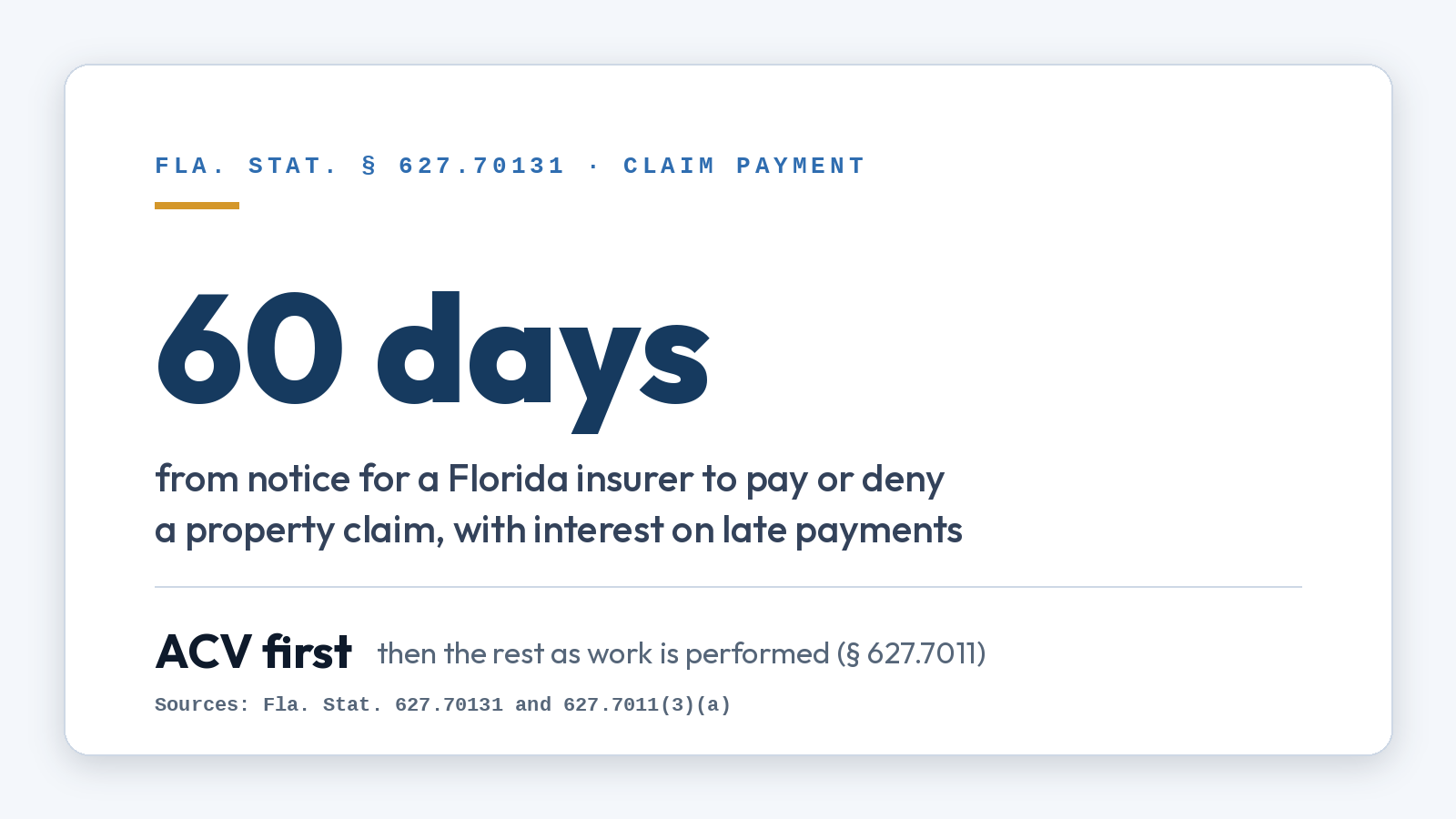
- Florida puts insurers on a clock: pay or deny within 60 days of notice under § 627.70131. South Carolina requires claims be handled with reasonable promptness under S.C. Code Ann. § 38-59-20.
General information, not legal advice. Your policy controls.
The payment side of a claim gets less attention than the coverage side, and that is a mistake. We regularly meet homeowners whose claim was approved and who still cannot start repairs, because the check is sitting at a mortgage servicer, because the payment was only the depreciated value, or because they cashed the first check believing it was all there was. Knowing how the money moves is how you keep it moving.
What happens between "approved" and "paid"?
Payment is the end of a process that starts the day you report the loss. In outline:
- Notice of loss. You report the claim and get a claim number.
- Inspection. The carrier's adjuster (staff, independent, or a desk adjuster working from photos) inspects and documents the damage.
- Estimate. The adjuster writes a line-item estimate, usually in Xactimate, that prices the repair at replacement cost and then applies depreciation.
- Coverage decision. The carrier decides what is covered, what is excluded, and which deductible applies.
- Proof of loss. Many policies require a signed, sworn proof of loss stating the amount claimed. Some carriers request it; some send a pre-filled one to sign.
- Payment letter and first check. You receive a statement of loss explaining the math and the first payment.
- Supplements and holdback releases. Additional payments follow as hidden damage is claimed and as repairs are completed.
The widely used HO-3 policy form sets the basic timing rule in its Loss Payment condition: loss is payable 60 days after the insurer receives your proof of loss and either reaches an agreement with you, a court enters a final judgment, or an appraisal award is filed. You can read that condition in the sample HO-3 form Triple-I publishes. State law can shorten that window, and in Florida it does.
Why is the first check smaller than the estimate?
Because the first check is not the estimate. It is the estimate minus three things.
| What comes off | What it is | Does it come back? |
|---|---|---|
| Deductible | Your share of the loss, set on your declarations page. In Florida and South Carolina, hurricane losses usually carry a separate percentage deductible | No |
| Recoverable depreciation | The age and wear reduction on items covered at replacement cost | Yes, once the repair or replacement is done and documented |
| Non-recoverable depreciation | Depreciation on items covered only at actual cash value (often roofs on ACV schedules, or contents on ACV policies) | No |
| Prior payments | Any advance or emergency payment already issued | Already paid to you |
Here is a simple example on a replacement cost policy:
| Line | Amount |
|---|---|
| Replacement cost of the repair (RCV) | $42,000 |
| Less recoverable depreciation | minus $9,500 |
| Actual cash value (ACV) | $32,500 |
| Less deductible | minus $2,500 |
| First payment | $30,000 |
| Recoverable depreciation, released after repairs | $9,500 |
| Total paid on the claim | $39,500 |
The $9,500 was never taken away. It was held. The NAIC's consumer guide explains the difference between the two valuation methods, and our recoverable depreciation guide walks through how to collect the held-back amount.
Pro tip: every payment letter should come with a statement of loss or estimate summary that shows RCV, depreciation, deductible, and net. If yours does not, ask for it in writing. You cannot check a number you cannot see, and the depreciation line is the one most often left unclaimed.
How Florida sequences replacement cost payments
Florida wrote the ACV-then-RCV sequence into statute. Under Fla. Stat. § 627.7011(3)(a), on a dwelling insured at replacement cost, the insurer must initially pay at least the actual cash value of the loss, less the deductible, and then pay any remaining amounts necessary to perform the repairs as work is performed and expenses are incurred. On a total loss, the insurer must pay the replacement cost without reservation or holdback of depreciation. Where a separate roof deductible applies, the same section lets the insurer limit the roof payment to ACV until it receives reasonable proof of payment for the work, which we covered in our new roof guide.
Florida also sets the clock. Under § 627.70131, an insurer must acknowledge claim communications within 7 days, begin its investigation and inspect within the statute's windows, and pay or deny the claim within 60 days after receiving notice of it, unless factors beyond its control reasonably prevent that. The statute also provides for interest on claim payments made late. Our Florida claim deadlines guide lays out the full timeline, including the one-year window to report a new claim under § 627.70132.
How South Carolina handles claim payment
South Carolina does not use fixed day counts for most claim handling. S.C. Code Ann. § 38-59-20 requires insurers to handle and settle claims with reasonable promptness and in good faith. Two specific protections apply: if the insurer must furnish proof-of-loss forms, it has 20 days to do so under § 38-59-10, and if it refuses to pay without reasonable cause or in bad faith, you may be able to recover attorney's fees under § 38-59-40.
In practice that means the policy's own Loss Payment condition, commonly the 60-days-after-proof-of-loss language above, is the timing rule most South Carolina homeowners are working with. Replacement cost and actual cash value work the way your policy defines them; there is no SC statute prescribing the payment sequence. Our South Carolina claims guide covers the rest.
Why is my mortgage company's name on the check?
Almost every mortgage requires you to carry property insurance and name the lender as mortgagee. The HO-3's Mortgage Clause makes covered dwelling losses payable to the mortgagee and you "as interests appear." The result is a two-party (or three-party, if a contractor is also named) check that you cannot deposit on your own.
What happens next depends on the servicer, not the insurer:
- You endorse the check and send it to the servicer's loss draft department.
- The servicer deposits it into a restricted escrow account, especially on larger losses, and releases funds in stages: often an initial draw, then further draws after inspections show progress.
- The servicer may require a contractor agreement, a W-9, a lien waiver, a signed release form, and an inspection before each draw.
- On smaller losses or loans in good standing, some servicers endorse the check back to you with no escrow.
None of this changes what the insurer owes. It changes how fast the money reaches the contractor. Call the loss draft department the day the check arrives, ask for their written requirements, and ask what triggers each release.
Pro tip: contents and additional living expense payments usually are not subject to the mortgage clause, because the lender has no interest in your furniture or your hotel bill. If those are coming on the same check as the dwelling, ask the carrier to split them into separate payments. It is a routine request and it keeps money you need now out of a servicer's escrow.
What payments can come on a single claim?
A full homeowners claim can produce several distinct payment streams, each from a different part of the policy:
| Coverage | What it pays | Typical payee |
|---|---|---|
| Coverage A (dwelling) | Repairs to the house itself | You and your mortgage company |
| Coverage B (other structures) | Fences, sheds, detached garages | You and, often, your mortgage company |
| Coverage C (personal property) | Contents, usually from an itemized inventory | You |
| Coverage D (loss of use / ALE) | Extra living costs while you are displaced | You, or directly to a hotel or rental |
| Emergency services | Water mitigation, tarping, board-up | You, or directly to the vendor if you signed an assignment or direction to pay |
| Supplements | Damage found after the first estimate | Same as the coverage it falls under |
| Recoverable depreciation | Holdback released after completion | Same as the original payment |
Each of those may arrive on its own schedule. A contents claim can take longer than the dwelling claim because every item has to be listed and valued. Additional living expenses are paid as incurred. Supplements follow the work.
Does cashing the first check mean I accept it?
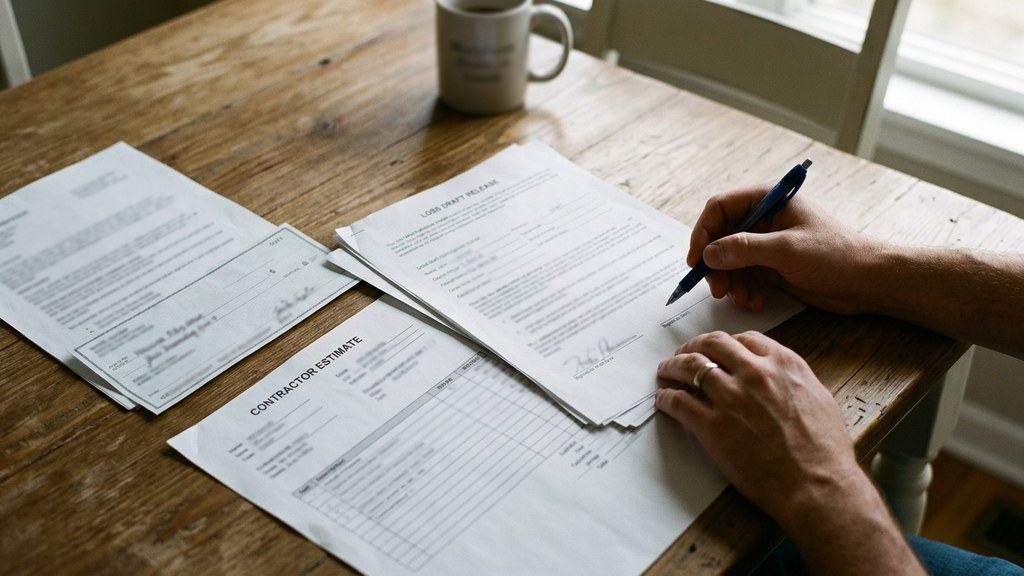
Generally, no. Depositing a partial payment for the undisputed amount does not, by itself, waive your right to claim more. But read what you are signing. A document labeled release, full and final settlement, or a check with restrictive language on the back is different. If a check or form says it settles the claim in full, stop and get advice before you sign or deposit it.
The safer path when you disagree with the amount is to deposit the undisputed payment, put your disagreement in writing, and keep working the claim through a supplement, a reinspection request, or, where the policy provides it, appraisal.
How long does it take to get paid?
It depends on the size and complexity of the loss more than anything else.
- Small, clear losses (a single-room water loss, a few roof slopes) often pay within a few weeks of inspection.
- Large losses (fire, major hurricane damage) pay in stages over months as scope, contents, and ALE are worked through.
- Catastrophe periods slow everything, because every carrier is handling thousands of claims at once and the adjusting workforce is stretched.
In Florida, the 60-day pay-or-deny deadline in § 627.70131 governs the coverage decision and initial payment, not how long a rebuild takes. The fastest way to shorten any claim is a complete file: photographs, an itemized scope, receipts, and a signed proof of loss when requested.
What we see in the field
The most common payment problem we see is the unclaimed holdback. Homeowners complete the repair, pay the contractor out of pocket for the difference, and never send the carrier the invoice that releases the recoverable depreciation. The policy owed that money. Nobody asked for it.
The second is the stalled mortgage check. The claim is paid in the insurer's system, the homeowner has a signed contractor, and the funds sit in a servicer's loss draft account for weeks waiting on a form nobody told the homeowner about. We now ask for the servicer's requirements on day one.
The third is the first check read as the final number. A homeowner assumes the approved estimate is the ceiling, when it was the carrier's opening scope and missed code items, interior water damage, or contents entirely. The first payment is a floor to build on, not a verdict.
How Vanguard Claims Solutions helps
We are licensed public adjusters. We represent you, never the insurer, and on the payment side of a claim that means we:
- Read every payment letter against the policy and the estimate, so you know exactly what was paid, what was held back, and what is still owed.
- Build the complete scope before the carrier's estimate becomes the only number in the file.
- Track the holdbacks and supplements through completion so recoverable depreciation and hidden damage are actually claimed.
- Work with your mortgage servicer's loss draft process so approved money reaches the repair.
There are no upfront fees and no recovery, no fee. The fee for your claim is set out in the written contingency agreement before you sign anything.
Andrew Pichardo · FL Public Adjuster Lic. #W493213 · SC Public Adjuster License #18873906
Call (305) 336-3302 or request a free claim review.
Key takeaways
| Question | Short answer |
|---|---|
| Is a claim paid in one check? | Usually not. Expect an initial payment, then supplements and depreciation releases |
| What is the first payment based on? | On replacement cost policies, typically actual cash value minus the deductible |
| When is recoverable depreciation paid? | After the repair or replacement is completed and documented |
| Why is my lender on the check? | The mortgage clause makes dwelling losses payable to you and the mortgagee |
| Florida payment deadline? | Pay or deny within 60 days of notice (§ 627.70131); ACV first, remainder as work is performed (§ 627.7011) |
| South Carolina payment rule? | Reasonable promptness and good faith (§ 38-59-20); policy's loss payment condition sets the timing |
| Does depositing a partial check end my claim? | Generally not, unless you sign a release or full-settlement document |
FAQ
How do insurance companies pay out homeowners claims?
Usually in stages. The insurer pays an initial amount, typically the actual cash value of the covered damage minus your deductible, then pays supplements for additional damage and releases recoverable depreciation after repairs are completed. Dwelling payments are usually made out to you and your mortgage company. Contents and living expense payments typically go to you directly.
Why did my insurance check come with my mortgage company's name on it?
Your mortgage requires the lender to be named on the policy, and the policy's mortgage clause makes dwelling losses payable to you and the lender as their interests appear. You endorse the check to the servicer's loss draft department, which may release it in stages as repairs progress. Ask the servicer for its written requirements as soon as the check arrives.
How long does an insurance company have to pay a claim in Florida?
Under Fla. Stat. § 627.70131, an insurer must pay or deny a property claim within 60 days after receiving notice of it, unless factors beyond its control reasonably prevent it, and late payments can carry interest. On a replacement cost dwelling claim, § 627.7011 requires the insurer to pay at least actual cash value first and the rest as work is performed.
Can I keep the insurance money and not make repairs?
It depends on the policy and your mortgage. On a replacement cost policy you can usually keep the actual cash value payment, but you forfeit the recoverable depreciation if you never repair or replace. If you have a mortgage, the lender has a claim on dwelling funds and will typically require the repairs. Talk to your lender and read your policy before deciding.
Should I deposit the first check if I disagree with the amount?
Generally yes, if it is a partial payment for the undisputed amount and nothing you sign calls it a full and final settlement. Put your disagreement in writing and keep working the claim through supplements, reinspection, or appraisal. If a check or document says it settles the claim in full, get advice before you sign or cash it.
Recommended reading
Dealing with this claim right now?
A licensed adjuster will review your loss and policy for free, with no obligation.